A Customer Story: ACULP
Producing Upper Limb Prosthetics with HP

https://www.unb.ca/ibme/limb-clinic/
Industry:
Medical Devices & Life Sciences
"One of the most vital aspects of the MJF workflow at ACULP is the ability to achieve high-fidelity aesthetics."
How ACULP is Redefining the Possible in Prosthetics
For over 70 years, the standard for making a prosthetic limb has been a process called socket lamination. It is a manual, labor-intensive craft involving plaster casting and harsh chemical resins. While this is the way things have always been done, Dan Dafonseca, Prosthetic Research Designer at the Atlantic Clinic for Upper Limb Prosthetics (ACULP), puts it bluntly: "It’s archaic".
Located within the University of New Brunswick’s Institute of Biomedical Engineering (IBME), ACULP’s mission is deeply rooted in engineering resilience. The clinic’s legacy dates back to the Thalidomide crisis of the 1960s, when a specialized research team formed specifically to help infants born with congenital limb differences. That original mission of solving complex upper-limb cases is what led the clinic to eventually leave traditional methods behind.
Today, by moving to a 90% digital workflow powered by HP Multi Jet Fusion (MJF) technology, they have quadrupled their production speed and unlocked a level of personalization that was once impossible.
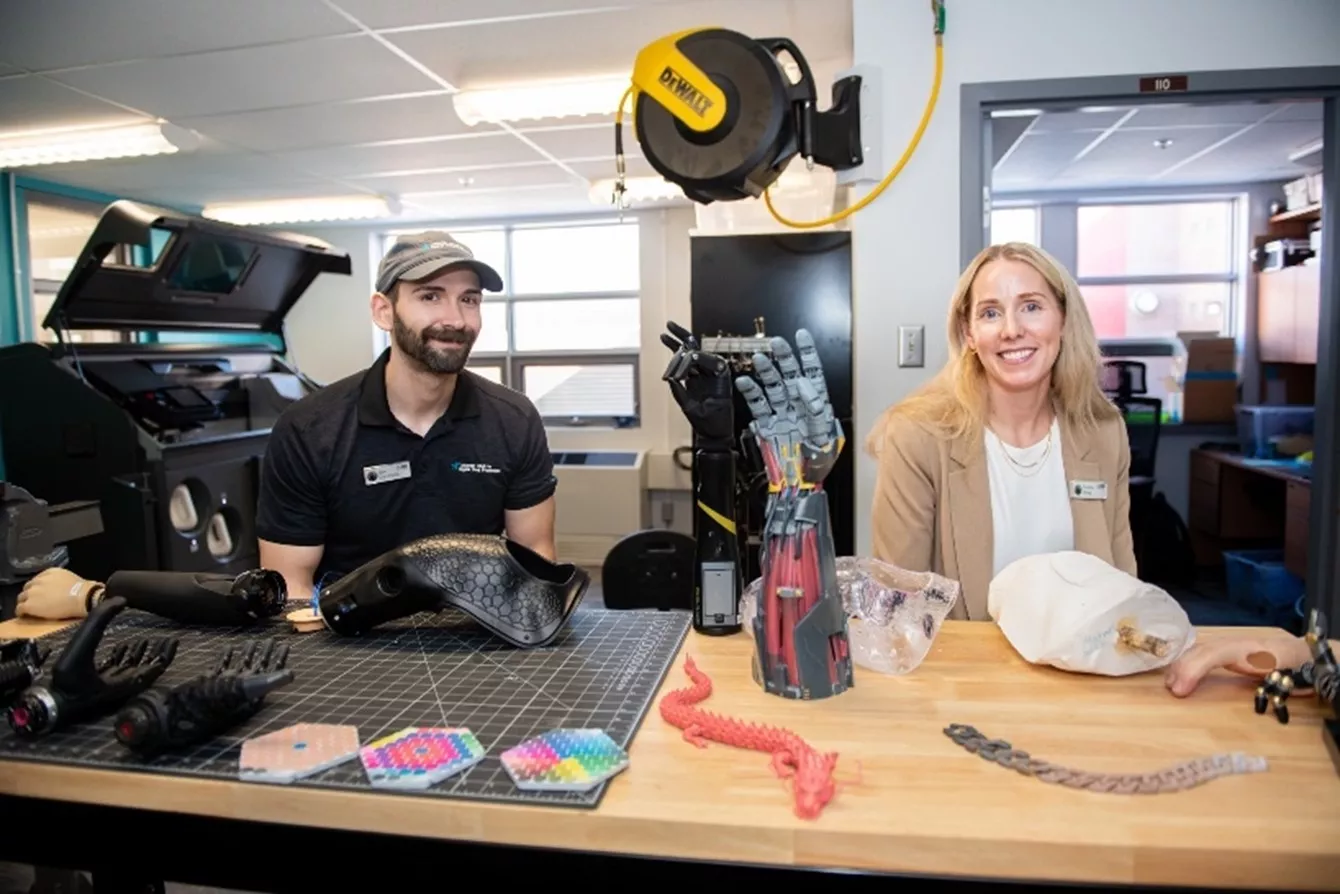
Dan Dafonseca, Prosthetic Research Designer, and Heather Daley, Research Prosthetist, ACULP
The Path of the "Arm Mechanic"
Dan’s transition into additive manufacturing wasn't a sudden corporate mandate. It was a journey driven by his own curiosity and a refusal to accept the limitations of the status quo. He started small, experimenting with desktop FDM printers for basic prototypes. Eventually, he began ordering MJF parts from service bureaus to test their strength and durability.
He quickly realized that to truly transform the clinic, he had to bring the technology in-house. But the transition involved a significant learning curve. In an industry where tradition is the default, Dan had to take the initiative to learn new software and hardware while navigating the field's "this is how it’s always been done" mentality.
For Dan, the turning point was a realization of the massive physical and mental toll required by traditional lamination. The old process is a high-stakes gamble; a single fabrication error or starvation in the resin can ruin a part at the very last second, instantly erasing many hours of labor. Between the risk of repetitive strain injuries and the inefficiency of "starting from scratch," Dan reached a point of no return.
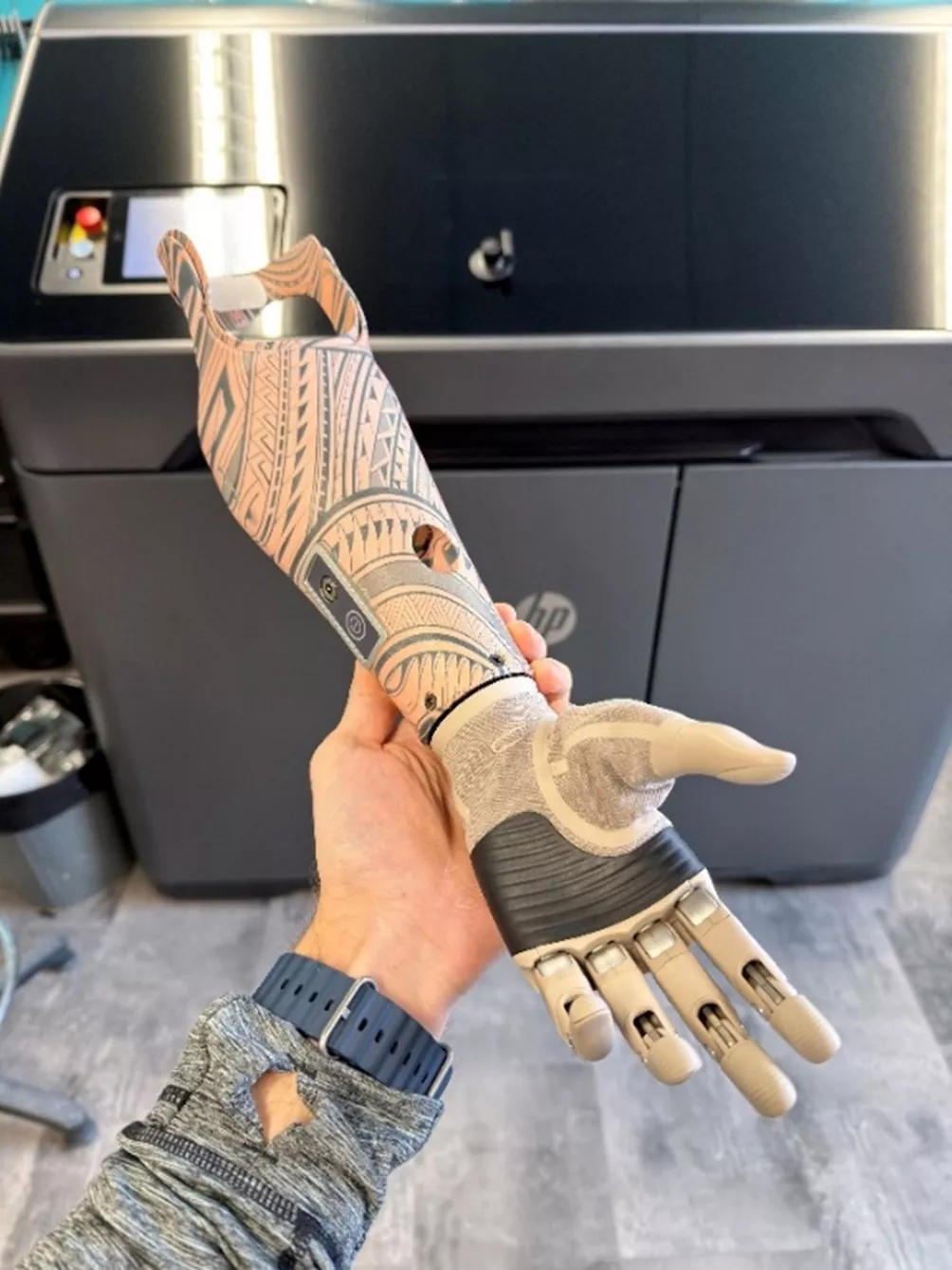
"I sometimes ask, what would we do if the printer died all of a sudden?" Dan says. "I would never go back to lamination. I would order parts from a service bureau before I ever went back to that." This conviction is born from seeing the massive gap in quality between a hand-laminated socket and a digitally designed, MJF-printed device.
Digital Advantage: Precision Meets Speed
The shift to digital hasn't just saved Dan’s hands; it has improved the lives of the clinic’s clients. The workflow at ACULP is a masterclass in modern engineering. Dan uses a handheld portable scanner to capture the exact shape of a modified plaster mold, ensuring a perfect fit that respects sensitive pressure points.
He then designs the device in Geomagic Freeform using a haptic "Touch" device. This is a robotic arm that allows him to literally feel the digital model as he carves and shapes it on screen. Because the process is now 90% digital, the predictability is a massive relief. What could take many weeks of fabrication for a certain device now takes a couple of days.
The Importance of Personalization
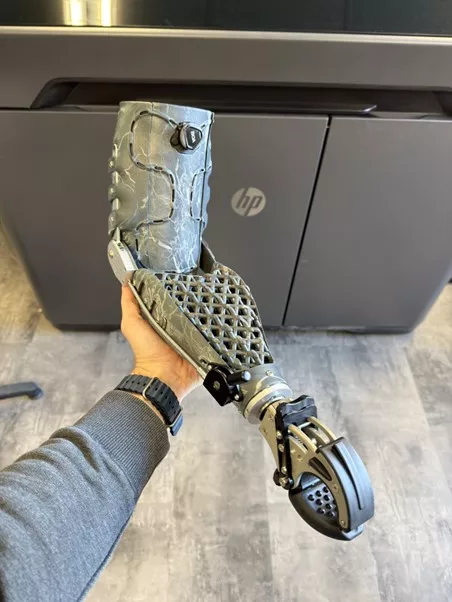
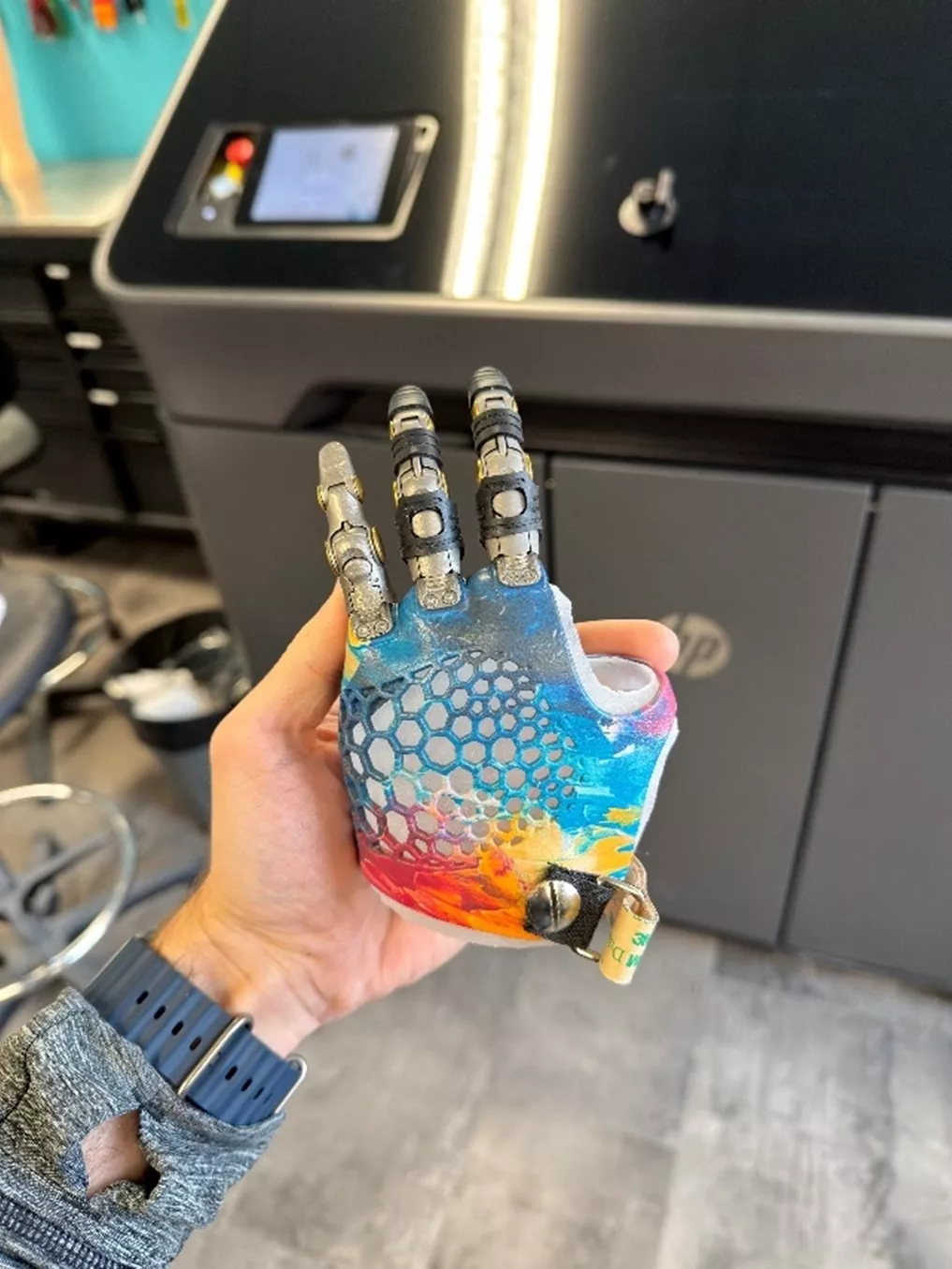
One of the most vital aspects of the MJF workflow at ACULP is the ability to achieve high-fidelity aesthetics. For Dan and the ACULP team, the look of a prosthesis isn't just about "flair"; it’s a necessity for client connection and well-being.
The digital process allows for a level of expressive customization that traditional methods couldn't touch. For children, this means turning a medical device into a point of pride by incorporating vibrant designs, like rainbows and unicorns, directly into the structure. For adults, the focus is often on achieving a sleek, modern finish or matching skin tones.
"These perks have helped clients get excited about their devices," Dan notes. "It helps them feel more accepting of them and happy to show them off."
Advice to the O&P Industry
Despite the clear benefits, many Canadian clinics remain hesitant to adopt additive manufacturing. When asked what is holding the industry back, Dan doesn't pull his punches.
"The biggest anchor is definitely tradition, but time and money are a very close second," Dan says. He recognizes that for many, the sheer intimidation of the learning curve is what keeps them on the sidelines. "It’s a massive shift in how you work, and I understand why that’s intimidating, but slowly, the rest of the world is advancing forward. This leap is for those with the initiative and the desire to do more and do better for their patients."
Dan acknowledges that the transition requires a dedicated "champion" within the staff – someone willing to take ownership of the technology and navigate the initial facility modifications and training. But in his view, the cost of staying stagnant is far higher than the cost of moving forward.
A Partnership Built on Support
Transitioning a clinic to a high-tech digital lab requires more than just a printer. It requires a technical backbone. That is where the partnership with GoEngineer comes in.
The team at GoEngineer has become a vital support system that helps keep the clinic running if a challenge arises. Whether it’s exploring new material applications or providing the support needed to keep a complex operation moving, GoEngineer has stepped in as the enabler of ACULP’s innovation.
The Next Frontier
As ACULP looks toward the future, they aren't slowing down. Dan is already experimenting with various materials and technologies, including the potential for 3D printed silicone to create even more comfortable, life-like interfaces for the clinic's clients.
By pairing the deep history of the IBME with the specialized engineering support of GoEngineer, Dan and the ACULP team are building a future where prostheses are lighter, more capable, and more human than ever before.
Ready to digitize your workflow?
Whether you are looking to reduce weight, increase production speed, or offer your clients a new level of customization, GoEngineer has the expertise to help you get there.
Contact our team* to learn more about our medical and O&P solutions.

*HP 3D printers are available in Canada only. View all Canadian hardware solutions.
Additional Resources
Take Advantage of GoEngineer’s Extensive Knowledge Base and Resources

Find a Solution
Our robust Knowledge Base contains over 12,000 resources to help answer your product design questions. From basic CAD questions to in-depth guides and tutorials, find your solution here. Find a Solution
PROFESSIONAL TRAINING
Improve your skills with professional training and certifications in SOLIDWORKS, CAM, 3D Printing, and 3D Scanning offered four ways: self-paced, online, on-site, or in-classroom. Certified Training Courses
BLOG
#1 Technical Resource Worldwide - Right at your fingertips. Search or browse through hundreds of SOLIDWORKS tips & tricks, additive manufacturing product developments, announcements, how-to guides, and tutorials. Blog

YouTube Channel
Our YouTube channel hosts hundreds of educational tutorials, product demonstrations, recorded webinars, and best practices for all of our products and services. GoEngineer's YouTube Channel
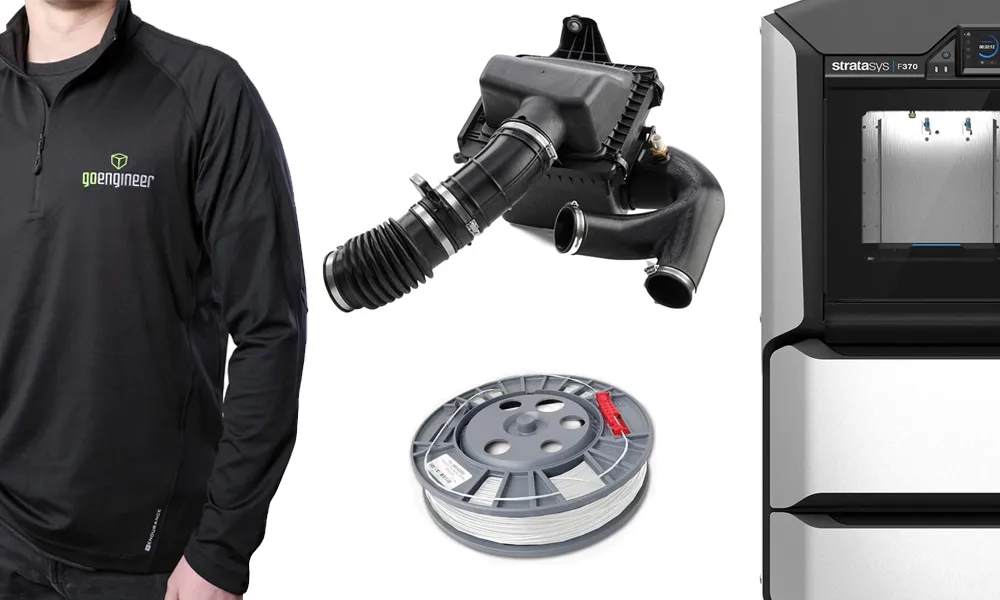
ONLINE STORE
Order 3D printing materials and consumables, enroll in SOLIDWORKS training classes, and buy official GoEngineer gear directly from our online store. Online Store
WEBINARS
Our engineering webinars are hosted by some of the top experts in the industry. They are always recorded, always free, and always offer a live Q&A. WEBINARS
3D Printing Services
Need to 3D print a part? Our Additive Manufacturing experts will 3D print your part and deliver it to you using the latest technology on one of our professional FDM, PolyJet and SL 3D printers. 3D Printing Services