
If you're a SOLIDWORKS or CATIA user, there's a good chance you've encountered the word DELMIA. You probably saw it in a trade show booth, a vendor email, or heard it in a passing conversation, but walked away wanting more clarity. That's a natural reaction. DELMIA spans so many product areas and planning horizons that it resists any single, tidy explanation, and conversations about it can feel like they're talking past each other.
The confusion is a shame, because once you understand what DELMIA actually is, the picture that emerges is compelling: a broad, mature portfolio of manufacturing software that addresses the full operational lifecycle—from supply-chain strategy down to individual work instructions on the shop floor. For many SOLIDWORKS and CATIA customers, there is almost certainly something within that portfolio worth serious attention.
This article cuts through the noise and explains what DELMIA is, what it emphatically is not, the ambitious vision behind it, and (crucially) why it matters to the engineers and manufacturers already invested in the Dassault Systèmes ecosystem.
First, let's clear the air
What DELMIA Is Not
Once upon a time, DELMIA was an acronym: Digital Enterprise Lean Manufacturing Interactive Application. That era is over. DELMIA has grown so far beyond that original scope that the acronym is now a vestige at best and a misdirection at worst.
Delmia is not
- A single application
- Exclusively about "lean" manufacturing
- A standalone ERP or MRP system
- The same thing as DELMIAWorks
- A minor add-on to CATIA or SOLIDWORKS
Delmia is
- A portfolio of distinct, enterprise-grade products
- Focused on manufacturing operations, logistics, and planning
- Built to integrate with your existing ERP
- A separate brand from DELMIAWorks
- The manufacturing layer of the 3DEXPERIENCE ecosystem
The DELMIAWorks confusion deserves special attention. DELMIAWorks is a self-contained ERP and MES platform designed for small to mid-sized manufacturers who need an all-in-one operations backbone. It's a capable product, but it occupies a completely different market than the DELMIA portfolio this article is about. If you already run SAP, Oracle, Microsoft Dynamics, or a similar enterprise ERP, DELMIAWorks is not the conversation to be having, but the broader DELMIA portfolio almost certainly is.
And if someone uses DELMIA to mean a specific piece of software without clarifying which one, it's always worth asking for more detail. The portfolio is large enough that the distinction genuinely matters.
The short answer
What Delmia Is
DELMIA is Dassault Systèmes's portfolio of software for manufacturing engineering and process planning, plant execution (MOM/MES), advanced planning and scheduling (APS), and supply-chain optimization.
Each product in the portfolio is powerful on its own terms, delivering measurable operational and financial benefits at its respective level. Companies regularly implement one or two DELMIA solutions independently of the others, and that is a completely reasonable approach.
The portfolio has been 25+ years in the making and has grown through a series of strategic acquisitions into a genuinely end-to-end manufacturing operations stack. The constituent products perform distinct functions across the manufacturing domain and work independently, but together can provide an integrated solution to plan, optimize, and execute production across an organization.
Manufacturing is where a company's greatest opportunity for cost and efficiency improvement actually lives, and Delmia is built entirely around that opportunity.
The big idea
The Vision: A Closed Loop from Design to Factory Floor
Understanding the individual DELMIA products is useful. Understanding the vision that connects them is transformative.
Dassault Systèmes' ultimate ambition with DELMIA is complete digital continuity across the entire manufacturing enterprise - a closed loop in which engineering design, manufacturing planning, production scheduling, shop-floor execution, and operational analytics are not separate data silos but a single, synchronized flow of information. The mechanism for that continuity is the 3DEXPERIENCE platform, the cloud-based data backbone that hosts CAD, PLM, and DELMIA data in a common environment.

This isn't merely an integration story. The deeper concept here is the digital twin: a complete virtual model of a product, its operational behavior, and the manufacturing process used to produce it. Before a company commits physical resources (people, machines, materials, energy) to a new product or process, it can validate and optimize everything in a virtual environment. Simulation before execution. Prediction before investment.
The virtual twin helps during design and execution, allowing companies to:
- Derive the manufacturing BOM directly from the engineering BOM, with full associativity and traceability — MBOM and EBOM side-by-side in the PLM structure, not maintained separately in spreadsheets.
- Develop a product's manufacturing plan inside a virtual factory model, then validate and optimize before a single production order is released.
- Release a manufacturing plan (plant layout, NC programs, work instructions, robot routines) pushed digitally to the shop floor the moment it's approved.
- Make decisions informed by live production, not month-old reports generated after the fact.
"Before committing people, machines, materials, or energy to an unproven process, validate and optimize it in the digital twin first."
That is the DELMIA vision. Not all customers pursue all of it at once - and they don't need to. But it explains why the portfolio exists the way it does, and why each layer is more valuable in the presence of the others.
The portfolio, explained plainly
The Four Layers of Delmia
The DELMIA portfolio maps cleanly onto four operational layers, each addressing a different aspect of manufacturing planning and operations. Think of them as nested scopes; the strategic level sets the context for the tactical level, which constrains the execution level, all underpinned by a shared data platform.
Strategic · 3–36 months
Supply-Chain Planning & Optimization
DELMIA Quintiq
Quintiq operates at the highest level of the stack: integrated business planning, sales & operations planning (S&OP), network design, workforce planning, and logistics planning. Its job is to answer the hardest strategic question in manufacturing: What should we make, where, when, and with what capacity (across our entire network) in order to hit our service and margin targets?
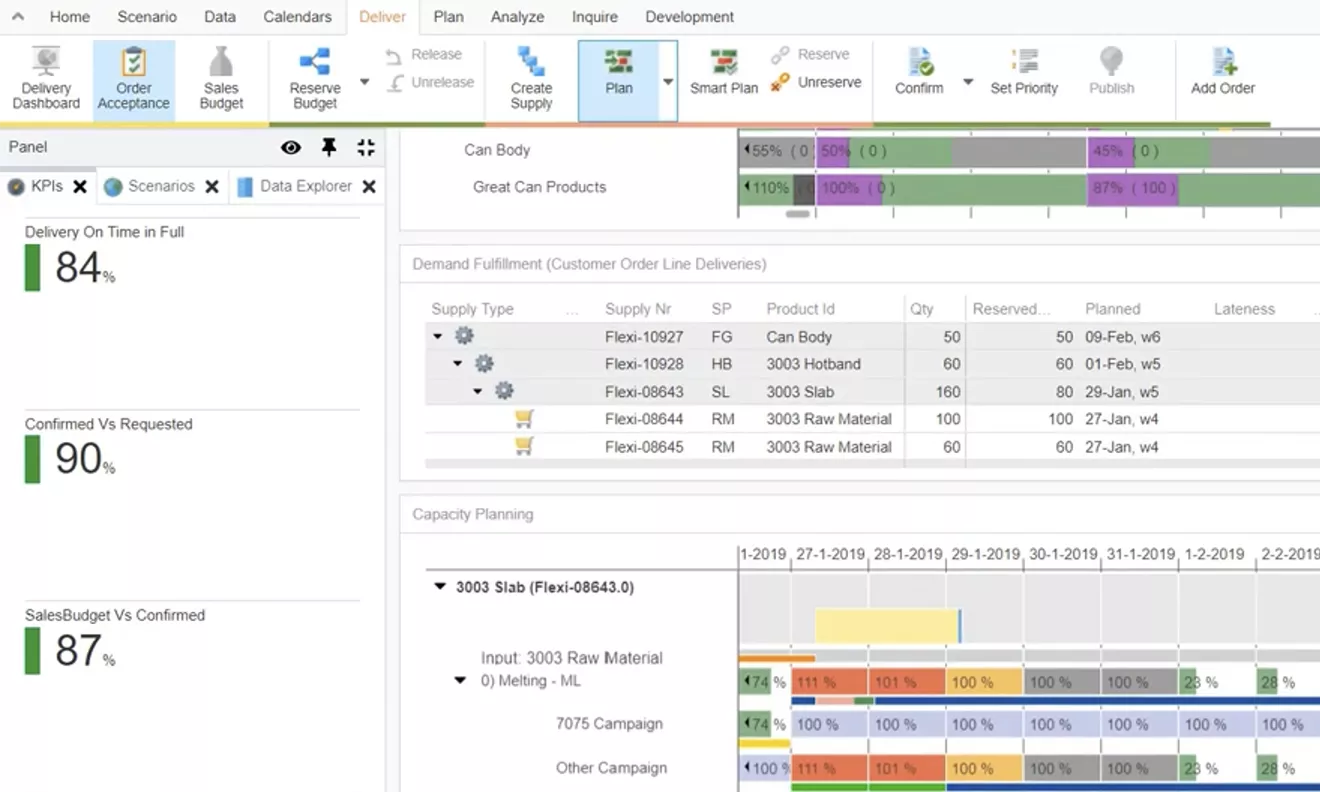
DELMIA Quintiq KPIs and planning
Tactical · 1–26 weeks
Finite-Capacity Planning & Scheduling
DELMIA Ortems
Where Quintiq deals in network-level strategy, Ortems works inside the plant. Ortems complements your ERP with an Advanced Planning & Scheduling (APS) system that produces constraint-aware, finite-capacity production plans: which orders run on which resources, in what sequence, honoring material availability, machine capacity, labor constraints, changeover times, and tooling.
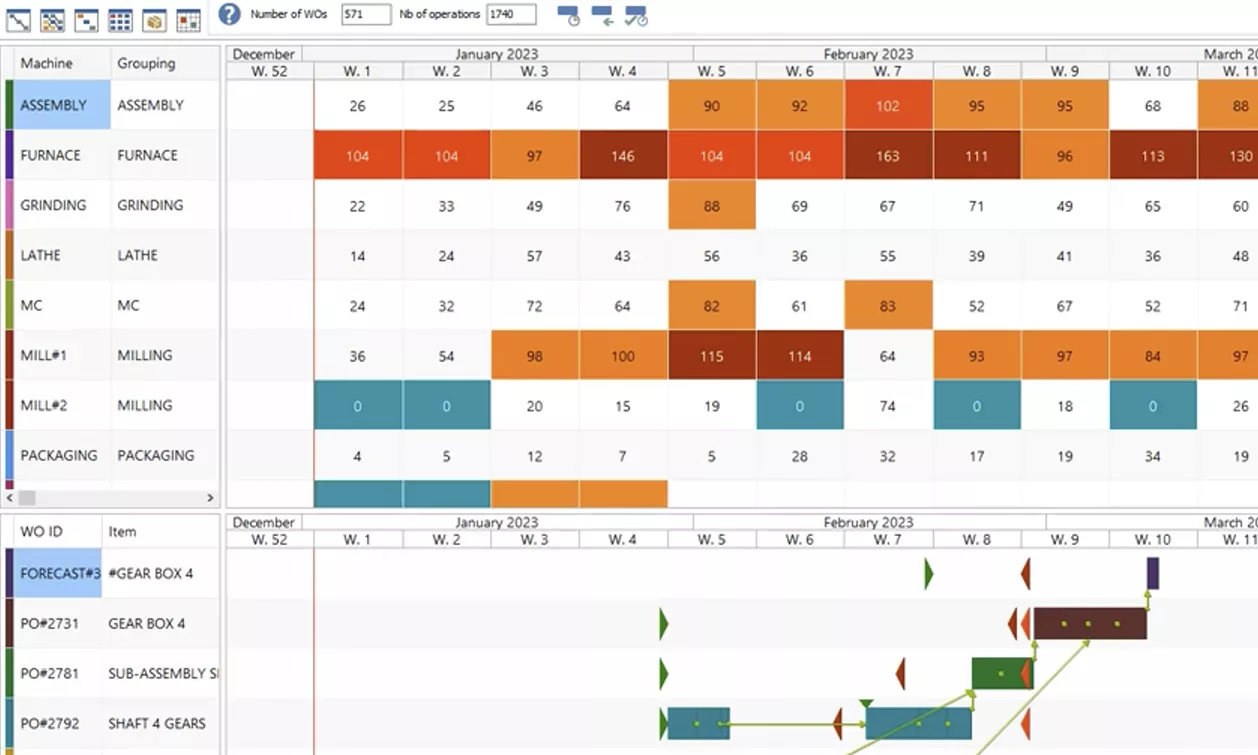
DELMIA Ortems Synchronized Requirements Planner
The result is a realistic, executable schedule, not a theoretical plan that MRP would generate by assuming unlimited capacity. Ortems is a daily and shift-level tool with the ability to re-plan intraday as conditions change. Short lead times, high schedule adherence, and fewer expediting crises are the practical payoff.
Execution · Real-time
Manufacturing Operations & Industrial Engineering
DELMIA Apriso + 3DEXPERIENCE Manufacturing Roles
This is the largest and most architecturally complex layer of DELMIA, and the one most directly connected to CATIA and SOLIDWORKS customers. It encompasses two related but distinct capabilities.
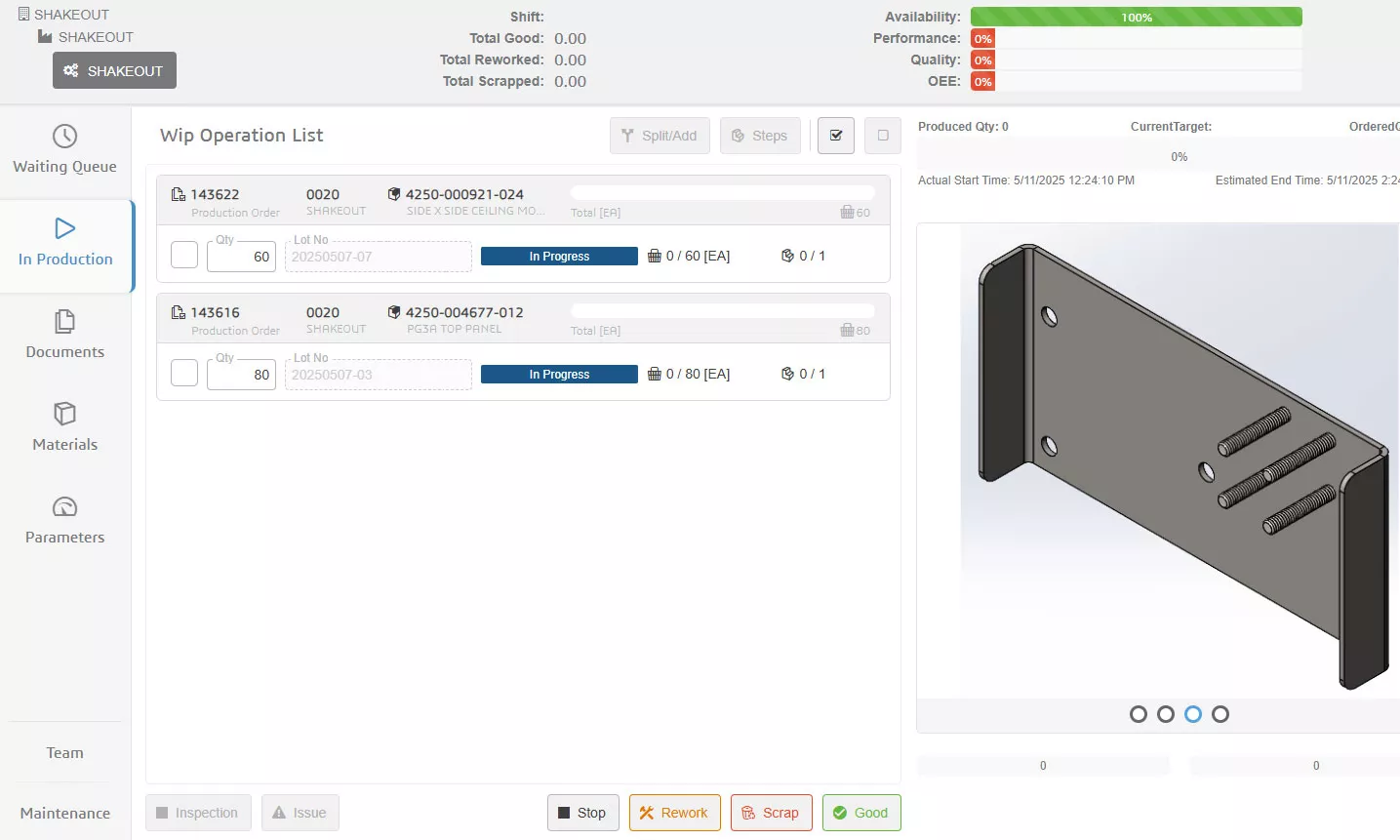 DELMIA Apriso fabrication console with 3D visualization
DELMIA Apriso is the MOM/MES - the system that governs real-time shop-floor execution, quality enforcement, material tracking, and production traceability. It answers the question "what happens on the floor right now?", dispatching work, collecting data, enforcing standard work sequences, and producing the compliance records required in regulated industries.
Upstream of Apriso, the 3DEXPERIENCE MANUFACTURING roles handle the engineering work that defines how things are made: factory layout and flow simulation, NC/CAM programming, robotics programming and virtual commissioning, additive manufacturing programming, manufacturing process planning (MBOM and Bill of Process authoring), work instruction creation, and human factors & ergonomics analysis.
Platform · Continuous
Unified Data, Governance & Collaboration
3DEXPERIENCE Platform with ENOVIA
Technically not a "DELMIA" product per se, but inseparable from the portfolio's full value proposition: the 3DEXPERIENCE platform, with ENOVIA governance, is the common data backbone that makes the other three layers coherent.
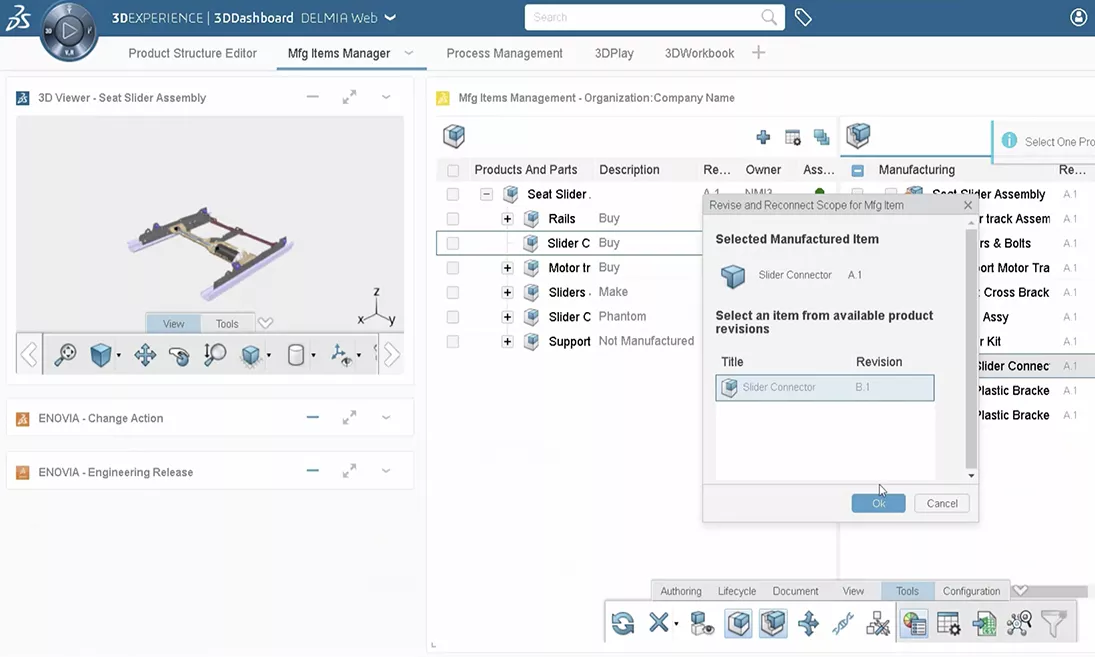
Manufacturing BOM on the 3DEXPERIENCE Platform
It provides a single source of truth for manufacturing BOMs, Bills of Process, effectivity, and change management and role-based access across engineering, planning, and operations. Without it, the data produced by the other layers would remain siloed; with it, a change in engineering propagates with full traceability to planning and execution. This is the infrastructure that makes "digital continuity" something more than a marketing phrase.
Why this matters to you specifically
The Case for SOLIDWORKS and CATIA Users
Here is the piece of the puzzle that often goes unsaid in DELMIA conversations: if your engineering data already lives in SOLIDWORKS or CATIA (particularly if you're on the 3DEXPERIENCE Platform), your organization is already closer to DELMIA than you might think.
The Bridge
SOLIDWORKS on 3DEXPERIENCE and CATIA are both native citizens of the same platform that hosts DELMIA's manufacturing layers. Your product geometry, design history, and engineering BOM are already in the ecosystem that DELMIA is designed to consume. The gap between your CAD environment and a digital manufacturing plan is smaller than it has ever been.
For CATIA users in particular (especially those in aerospace, defense, and automotive), the connection to the 3DEXPERIENCE MANUFACTURING roles is especially direct. The MBOM can be structured from the EBOM in the same environment where your engineers work. NC programming runs against the same design model. Simulation validates the same geometry.
For SOLIDWORKS users whose companies are growing in manufacturing complexity, the path to DELMIA solutions, like Ortems or Apriso, is a natural extension of an existing vendor relationship, with the added benefit of platform continuity if and when the engineering data migrates to 3DEXPERIENCE.
It is also worth noting what DELMIA brings to companies that don't yet have the full digital continuity picture. Quintiq, Ortems, and Apriso each integrate with third-party ERP systems. You do not need to be on 3DEXPERIENCE to benefit from better scheduling or real-time MES visibility. Many customers start with a single product, prove value at that layer, and expand over time.
Your product data is already in the ecosystem. DELMIA is the manufacturing layer waiting to consume it.
The bottom line
Where to Start
There is no single right entry point into the DELMIA portfolio, and that's intentional. The products were designed to deliver value independently, so companies can address their most pressing operational challenge first, without committing to a wholesale platform migration.
The most common starting points we see:
- Supply chain volatility and poor promise-date performance → DELMIA Quintiq
- Schedule chaos, long lead times, or excessive expediting → DELMIA Ortems (APS)
- Lack of shop-floor visibility, paper-based work instructions, or quality traceability gaps → DELMIA Apriso (MOM/MES)
- Disconnected engineering and manufacturing processes, or no MBOM discipline → 3DEXPERIENCE MANUFACTURING roles
If you're unsure which layer applies most urgently to your operation, or if you suspect the answer is "more than one", a structured assessment is the right first step. GoEngineer's manufacturing solutions team can help map your current-state challenges to the DELMIA portfolio and identify where the ROI case is strongest.