Windchill Migration 2026: Your Options, Risks, and Next Steps

Legacy Windchill license renewals will end after September 30, 2026. This announcement from PTC follows the news that support for Windchill version 13 ends in June 2027 (version 12 support ended in 2024). For engineering and IT leaders, this deadline represents far more than just a routine software upgrade. It's a strategic inflection point that demands a clear decision - and soon.
Whether your organization has relied on Windchill for two years or twenty, the path forward requires careful planning. Here's what you need to understand about your options, the risks of waiting, and how to approach this transition with confidence.
There Is No "Do Nothing" Option
Let's address the most common misconception first: this isn't a situation where inaction is a viable strategy. PTC's shift is part of a deliberate move to transition customers to ePLM role-based licensing, align deployments with cloud-ready architectures, and accelerate adoption of Windchill+ (their SaaS PLM offering).
Every Windchill customer must now choose a path forward. The only question is which one and when you start.
Why This Decision Is Harder Than It Looks
For most companies, this isn't simply a licensing change. Windchill environments tend to accumulate years of customizations, integrations with ERP and CAD tools, and embedded business processes that aren't easy to untangle.
That means most transitions involve:
- Data cleanup and restructuring: Years of product data rarely migrate cleanly.
- Customization, refactoring, or retirement: Bespoke workflows that work today may not translate to a new platform.
- Process standardization: SaaS (software-as-a-service) environments, in particular, enforce guardrails that reduce configuration flexibility.
- User retraining and change management: Even a smooth technical migration can fail without proper organizational preparation.
Companies that struggle most with PLM transitions are those that underestimate the preparation required.
Is It Time to Switch? Looking Beyond PTC
If a migration effort is unavoidable, regardless of which path you choose, it raises a natural question: why rebuild within the same ecosystem?
Staying with PTC by moving to Windchill+ means accepting a subscription cost model and SaaS limitations that restrict the very customizations your team has relied on.
That's why some organizations are treating 2026 not as a migration deadline, but as a platform reset; a chance to move to something better suited to how they work today.
Your 4 Strategic Paths Forward
1. Move to Windchill+ (Stay with PTC)
The most direct path is migrating to Windchill+, PTC's SaaS offering. This keeps your organization within the PTC ecosystem while transitioning to a managed, cloud-hosted environment.
This option is best for organizations satisfied with Windchill today, teams committed to PTC's long-term roadmap, and companies pursuing a SaaS-first IT strategy.
Key Benefits:
- Managed infrastructure with automatic upgrades
- Continuity of existing Windchill processes
- Alignment with PTC's innovation roadmap
What to Consider:
Windchill+ operates with SaaS guardrails, meaning customization flexibility is reduced. Organizations with heavily configured environments will need to review and rationalize those customizations before migration. This is a multi-phase transformation, not a simple lift-and-shift.
2. Simplify with SOLIDWORKS PDM or SOLIDWORKS Manage
For organizations whose primary PLM need is managing CAD files and engineering documents, particularly those running SOLIDWORKS, a right-sizing move may actually be the smartest option.
This option is best for engineering teams using SOLIDWORKS CAD, organizations seeking lower cost and administrative overhead, and companies that don't require a full enterprise PLM footprint.
SOLIDWORKS PDM and SOLIDWORKS Manage are tightly integrated with the tools your engineers use daily. Unlike Windchill, which was designed as an enterprise system that engineering teams were expected to adapt to, PDM and Manage are built around the SOLIDWORKS workflow, making adoption faster, administration simpler, and daily usage more intuitive.
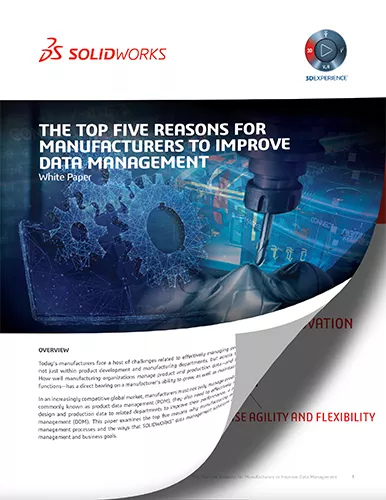
The Top Five Reasons for Manufacturers to Improve Data Management
Read this white paper to not only learn the top five reasons why manufacturing organizations should improve their data management, but how SOLIDWORKS data management solutions will help them achieve their business goals.
Key Benefits:
- SOLIDWORKS PDM gives you robust CAD file management, version and revision control, automated workflows, and bill of materials capabilities without the administrative overhead of a full enterprise PLM.
- SOLIDWORKS Manage adds project management, process management, and item management on top of PDM for teams that need more structure without full enterprise complexity.
- Both solutions have a meaningfully lower total cost of ownership than Windchill or Windchill+.
- Deployment timelines are significantly shorter.
What to Consider:
These platforms are not full enterprise PLM solutions. If your organization requires advanced lifecycle management, regulatory compliance workflows, or multi-domain collaboration, this path may not scale to those needs.
That said, for many mid-sized manufacturers, this is a practical and intelligent right-sizing decision, not a downgrade.
3. Transition to Enterprise PLM (ENOVIA/3DEXPERIENCE)
As we stated earlier, some organizations will use this moment as a catalyst to evaluate competing enterprise PLM platforms. Dassault Systèmes' 3DEXPERIENCE CLOUD PLM (also known as ENOVIA) is the most common alternative for companies seeking comparable or expanded capabilities.
This option is best for organizations requiring enterprise-grade PLM, companies pursuing a digital thread or digital twin strategy, and businesses needing cross-domain collaboration across engineering, manufacturing, and supply chain.
Unlike Windchill+, which is PTC's existing on-premise platform adapted for SaaS delivery, 3DEXPERIENCE was built cloud-native from the ground up. That distinction matters when you're evaluating long-term platform trajectory.
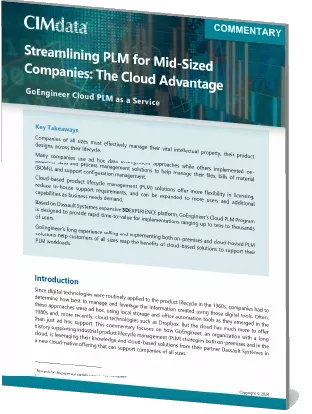
Streamlining PLM for Mid-Sized Companies: The Cloud Advantage
In this commentary, CIMdata dives into GoEngineer’s unique approach, showing how you can gain rapid time-to-value without a heavy in-house IT lift. Download the PDF now to learn about the advantages of cloud-based PLM tailored to your growth.
Key Benefits:
- A unified platform across your entire enterprise: Engineering, manufacturing, quality, supply chain, and project management all share the same data model, eliminating the silos that plague organizations running Windchill alongside separate project management and ERP tools.
- Built-in change and configuration management: Collaborative change processes, closed-loop issue resolution, and full traceability from concept through release are native capabilities, not add-ons.
- No information silos: Employees, partners, suppliers, and customers can collaborate within the same environment with role-based access, rather than exchanging documents and spreadsheets outside the system.
- Broad CAD compatibility: 3DEXPERIENCE supports SOLIDWORKS, CATIA, PTC Creo, Siemens NX, Autodesk Inventor, and more, so it isn't a platform that forces a CAD change.
- Scalable from mid-market to enterprise: GoEngineer offers an exclusive Cloud PLM bundle specifically designed for mid-sized companies, enabling rapid deployment (as little as 12–30 weeks) without the heavy IT lift typically associated with enterprise PLM.
- Lower total cost of ownership than on-premise: Cloud hosting, automatic updates, security, and backups are bundled into the subscription, removing the server hardware, SQL licensing, and IT maintenance costs that Windchill customers currently carry.
What to Consider:
Platform transitions of this scale require process redesign, data re-architecture, and substantial change management investment. This path is best approached as a deliberate strategic transformation, not a reactive one.
4. Bridge with an Overlay or Phased Approach
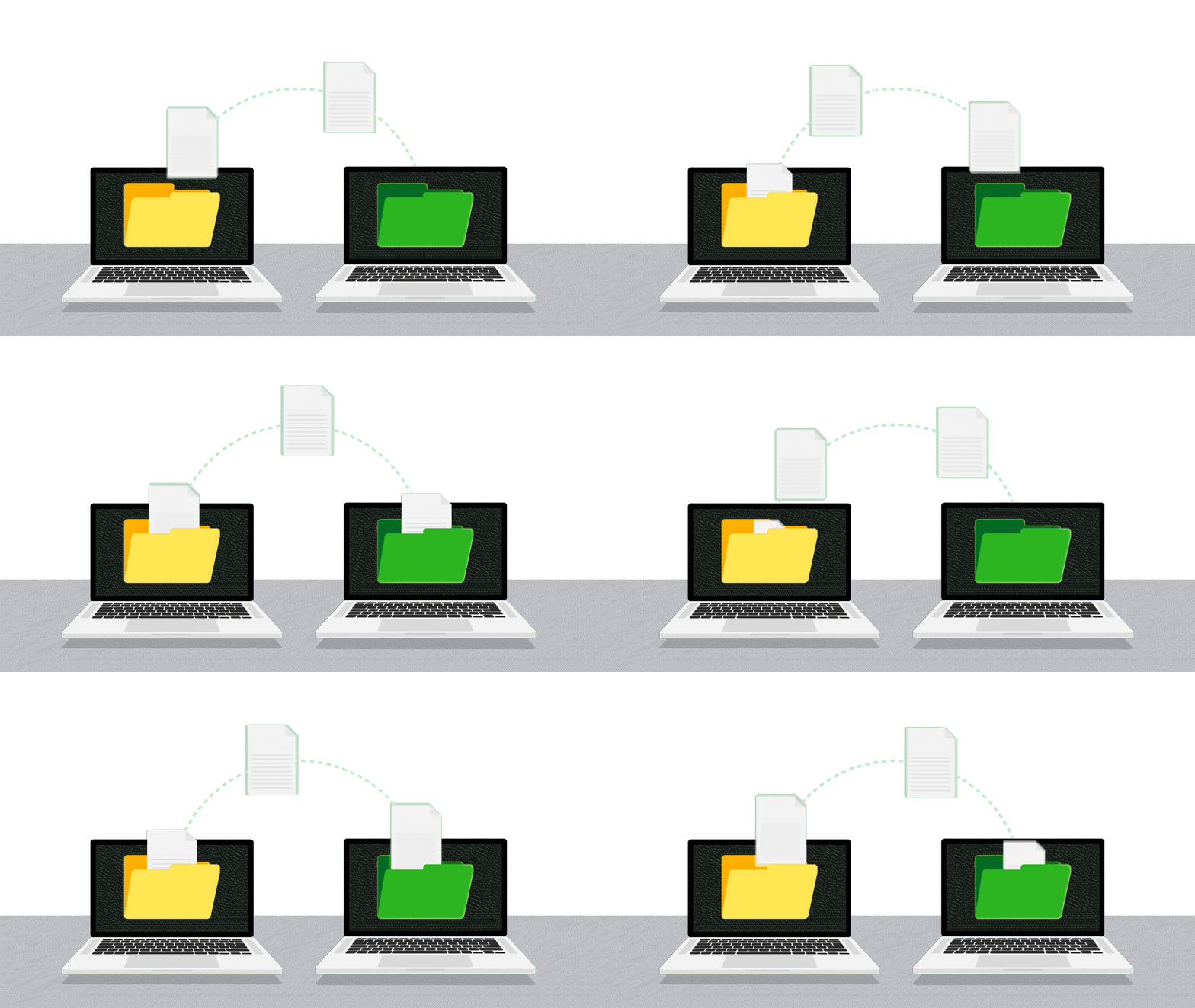
Connect your existing legacy Windchill to a more modern PLM solution, allowing Windchill to continue operating in the background. Keeping your integrations and release processes in place as you bridge the gap or transition to a new long-term PLM solution. This mitigates risks of a big bang migration strategy but does introduce additional IT burden for integration and coexistence strategies.
This option is best for organizations with heavily customized Windchill environments, companies that need time to build internal readiness, and businesses that want to defer a full platform decision while still addressing the 2026 deadline.
Key Benefits:
- Avoids compressing a complex migration into an unrealistic timeline
- Preserves existing investments while modernization work proceeds
- Allows incremental derisking of integrations and customizations
What to Consider:
This approach adds temporary architectural complexity and requires a clear long-term roadmap to avoid prolonged limbo. The goal is a controlled transition, not indefinite deferral.
How to Choose the Right Path
No two organizations will have the same answer, and the right choice depends on a clear-eyed assessment of your specific situation:
| Factor | Why It Matters |
| Customization depth | Heavily configured environments require more rework, regardless of platform |
| Integration landscape | ERP, MES, and CAD integrations may need re-architecting |
| Regulatory requirements | Compliance workflows may limit platform flexibility |
| Data quality and structure | Clean data is the foundation of any successful migration |
| IT and cloud strategy | SaaS adoption has organizational implications beyond PLM |
| Long-term business objectives | The right platform today should still be the right platform in 10 years |
A common mistake is letting urgency drive the decision. The September 2026 deadline is real, but committing to the wrong platform (or starting migration without proper preparation) can create far more cost and disruption than the deadline itself.
Start with a PLM Strategy Assessment
Across every path, one truth holds: the success of your transition depends more on preparation than platform choice.
Before committing to any direction, the most valuable first step is a structured assessment that covers:
- Current system evaluation: Where you are today, including technical debt and risk areas.
- Customization and integration analysis: What needs to change, and how much will it cost?
- Platform option comparison: An objective look at all viable paths, not just the one your current vendor recommends.
- Cost and risk modeling: What are the actual costs of each option, in terms of time, budget, and organizational effort?
- Strategic roadmap: A sequenced plan that aligns your PLM future with your business goals.
Organizations that invest in this step before making platform decisions consistently achieve faster migrations, lower costs, and better long-term outcomes.
The Bottom Line
The 2026 deadline is creating pressure... but it's also creating opportunity. Start your assessment now. Organizations that begin this process earliest will have the most options (and the least disruption) when September 2026 arrives.
We’re Here to Help
When the time comes to choose your path and execute your migration, having the right partner makes all the difference. GoEngineer has a dedicated team for handling the complexity of real-world PLM transitions - including migrations out of Windchill. Our data experts will assess the current state of your environment, identify risk areas, and map out the exact path forward.
About GoEngineer
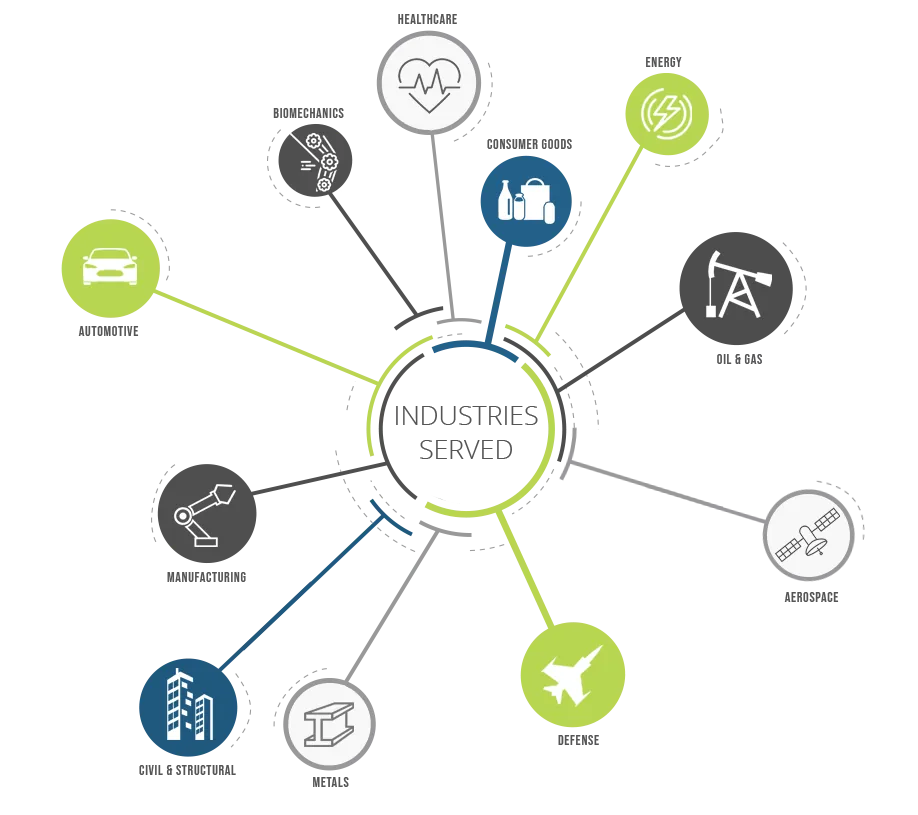
GoEngineer delivers software, technology, and expertise that enable companies to unlock design innovation and deliver better products faster. With more than 40 years of experience and tens of thousands of customers in high tech, medical, machine design, energy and other industries, GoEngineer provides best-in-class design solutions from SOLIDWORKS CAD, Stratasys 3D printing, Creaform & Artec 3D scanning, CAMWorks, PLM, and more
Get our wide array of technical resources delivered right to your inbox.
Unsubscribe at any time.