The Hidden Cost of Late Engineering Changes: $5 M for 15 mm

Late engineering changes rarely look dangerous when they first appear. In fact, many of them initially look like small, reasonable adjustments.
Early in my career, while working on a vehicle program, my team received a late-program change order related to an unanticipated rollover safety requirement. The request required a change to the vehicle "tumblehome" - an industry term for the angular slope of the vehicle's side windows from door line to roof. The change itself was simple: move the top of the side window frame outboard to provide 15 additional millimeters of head clearance.
A half-inch revision within the scope of an entire vehicle would be utterly inconsequential in the early stages, but because this change appeared late in the program, that subtle movement rippled through thousands of hours of mature design work, affecting nearly every visible surface on the vehicle:
- Door structure, roof geometry, glass, A-, B-, and C-pillars, exterior surfaces, interior surfaces, and body-in-white structure.
- NHTSA driver vision studies had to be repeated.
- Tooling assumptions changed.
- Expensive manufacturing prototypes became invalid.
All for 15 mm.
The Cost Curve Engineers Know Too Well
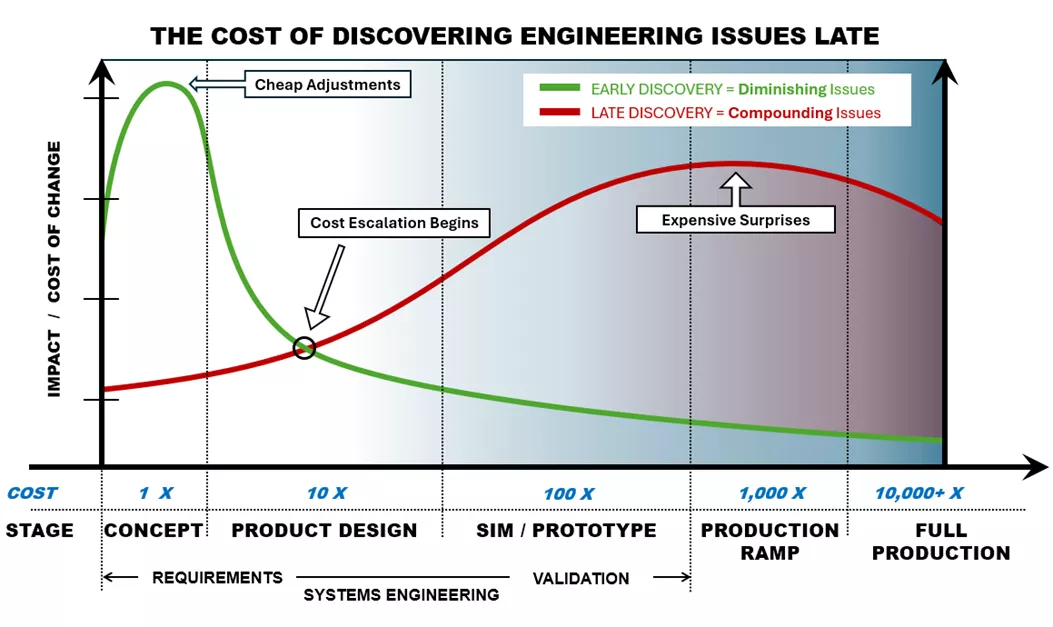
There is a well-known concept in product development often called the cost-of-change curve. The idea is simple: the later a problem is discovered in the product lifecycle, the more expensive it becomes to fix.
A change made during concept development might require only a design tweak and a few hours of engineering time. The same change discovered during prototype or production could affect dozens more components and trigger retooling, scrapping material, supplier updates, and cascading program delays.
The exact multipliers vary by industry and program, but the pattern is remarkably consistent.
Relative cost by lifecycle phase:
- Concept: 1x
- Design: 10x
- Prototype: 100x
- Production: 1000x
Research in systems engineering frequently shows that as much as 70–80% of a product’s lifecycle cost is effectively determined during early design decisions. In other words, the most expensive problems are the undiscovered ones.
Why Late Changes Still Happen
If the cost-of-change curve is so widely understood, why do engineering teams still encounter expensive late-stage changes? The answer is rarely poor engineering. More often, it is limited visibility into system-level interactions.
Modern products are complex systems made up of mechanical structures, electronics, software, manufacturing processes, and supply chains. Problems often remain hidden until those pieces begin interacting in the real program context. We see this in several patterns that appear repeatedly across industries:
Requirements and Design Drift Apart
Requirements often begin in documents or spreadsheets, while design evolves rapidly in digital modeling environments. As the design changes, traceability between requirements and implementation can weaken, allowing mismatches to remain hidden until late-stage program reviews.
System Interactions Appear During Integration
Subsystems often appear correct when evaluated independently. However, when integrated, unexpected interactions can appear. Interfaces conflict, tolerances stack, and performance assumptions prove incomplete.
Manufacturing Feedback Arrives Late
Design teams typically focus on geometry and performance. Manufacturing teams focus on producibility and process constraints. When those perspectives intersect late in the development cycle, engineering changes collide with tooling, fixtures, and supplier timelines.
This pattern is not unique to automotive programs. Aerospace, Defense, and Industrial Equipment programs see similar ripple effects when late engineering changes affect system interfaces. A seemingly localized issue can propagate across structures, electronics, manufacturing tooling, and certification requirements.
The Systems Engineering Perspective
From a systems engineering perspective, the challenge is not eliminating engineering changes. Product development is inherently iterative.
The real objective is discovering system-level issues as early as possible. High-performing engineering organizations typically push several activities earlier in the lifecycle:
- Modeling system behavior earlier
- Validating requirements against design earlier
- Incorporating manufacturing constraints earlier
- Maintaining traceability between requirements, design, and verification
These practices reflect the philosophy behind model-based systems engineering (MBSE), which seeks to make relationships within complex systems visible earlier in development. Because once the system reveals a problem late in development, the ripple effects can extend far beyond the original design.

A Practical Guide to Systems Modeling
MagicGrid® BOOK OF KNOWLEDGe
The MagicGrid Book of Knowledge is a comprehensive guide to the CATIA MagicGrid framework to MBSE.
Illustrated using the easy-to-understand model of a real-world system, it is an answer to all the questions you may have, starting from “why” and ending with “how”, which few of today’s available sources of information can answer.
The Real Lesson
Engineering changes are inevitable in complex product development. What determines their cost is not the size of the change. It is when the system reveals the problem.
The earlier a program can expose system-level issues, the cheaper they are to resolve. The later they appear, the more likely they are to ripple across tooling, suppliers, schedules, and entire engineering organizations.
In other words, the real cost of engineering changes is not the change itself. It is when you discover you need one.
Questions?
Have questions or want to learn more about MBSE? Check out our Buying Guide for Cameo MBSE, which answers the most frequently asked questions about the software, pricing, licensing options, and more. If you'd like to speak to someone directly, please contact us.
Related Articles
Benefits of Model-Based Systems Engineering (MBSE)
6 Reasons Designers Upgrade to CATIA
CATIA V5 vs 3DEXPERIENCE CATIA: Interface, Licensing, Installation, & Setup

About Danny Alcini
Danny Alcini is an Enterprise Account Executive with GoEngineer based out of Detroit, Michigan. He specializes in the Dassault Systèmes 3DEXPERIENCE platform technology, including CATIA, ENOVIA, DELMIA, and Cameo. With 35 years of hands-on experience spanning mechanical design, systems engineering, and PLM, Danny brings a practitioner's perspective that is grounded in real program experience across automotive, aerospace, defense, and industrial equipment. Before moving into an advisory role, he spent decades as a working design engineer, developing deep expertise in CATIA and engineering process automation. He now helps engineering organizations stay competitive through the adoption of modern tools and processes.
Get our wide array of technical resources delivered right to your inbox.
Unsubscribe at any time.