Building the Perfect EDU Lab: A Tiered Approach to Makerspace Excellence

In modern education, the makerspace has evolved from a luxury to a critical component of the engineering and technical curriculum. A well-designed makerspace provides students with the tactile experience necessary to bridge the gap between theoretical physics and real-world application. However, building the perfect lab is not a one-size-fits-all endeavor. It requires a strategic alignment of hardware, software, and support that scales with the institution's goals and the complexity of the curriculum.
To help educators navigate this journey, we have categorized makerspace development into three distinct tiers: the Foundation Makerspace, the Growth Makerspace, and the Complete Makerspace. This breakdown ensures that institutions can invest in technology that meets their current needs while providing a clear roadmap for future expansion.
Tier 1: The Foundation Makerspace
Establishing the Core Design-to-Fabrication Loop
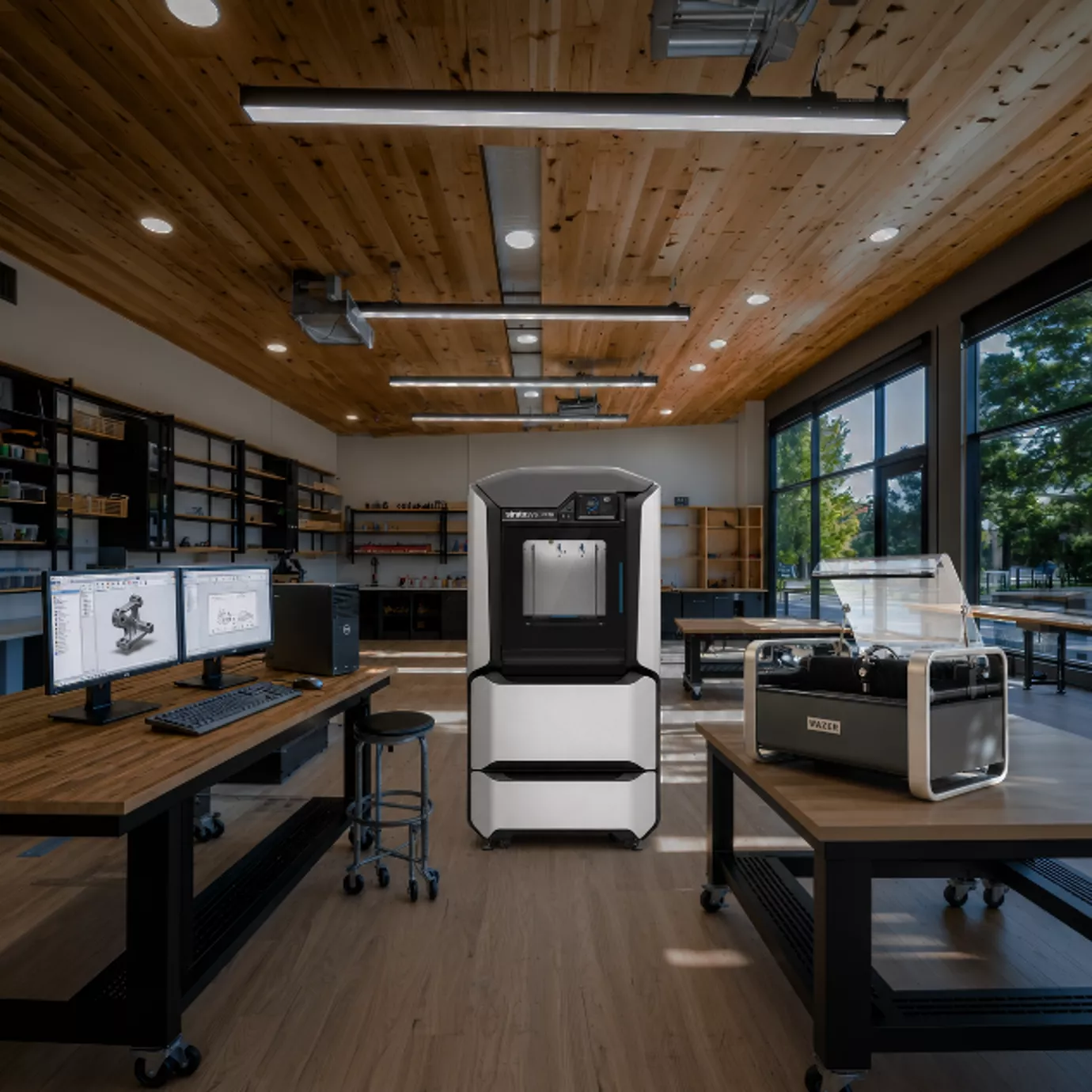
For institutions just beginning their journey into additive manufacturing and digital fabrication, the goal is to establish a reliable, repeatable design-to-part workflow. The Foundation Makerspace focuses on the most versatile and user-friendly technologies, ensuring that students can see immediate results with minimal downtime.
The Design Core: SOLIDWORKS EDU CAD
No makerspace is complete without a professional-grade design environment. Industry-standard CAD software such as SOLIDWORKS allows students to learn to use the same tools used by professional engineers worldwide. By starting with a robust parametric modeler, students develop the foundational skills of 3D modeling, assembly design, and technical drawing that will serve them throughout their careers. It is the software of choice for professional engineering design and documentation.
Reliability in Printing: Stratasys FDM 3D Printers
The backbone of any Tier 1 lab is Fused Deposition Modeling (FDM). Stratasys FDM 3D printers are selected for this stage because of their industrial-grade reliability. These systems are designed to handle thermoplastic prototyping with high consistency, allowing students to focus on their designs rather than troubleshooting the machine. Whether it is a simple bracket or a complex functional prototype, FDM provides a durable, repeatable entry point into the world of functional part production.
Versatile Cutting: WAZER Desktop Waterjet
Subtractive manufacturing is often an intimidating hurdle for new labs due to safety and space requirements. The WAZER Desktop Waterjet solves this by offering a compact system capable of cutting virtually any material, including metals, woods, rubber, stone, glass, and composites. Because it uses a high-pressure stream of water and abrasive rather than heat or high-speed blades, it is an exceptionally safe and accessible way for students to work with real materials early in their education.
Tier 2: The Growth Makerspace
Expanding Material Capabilities and Complex Workflows
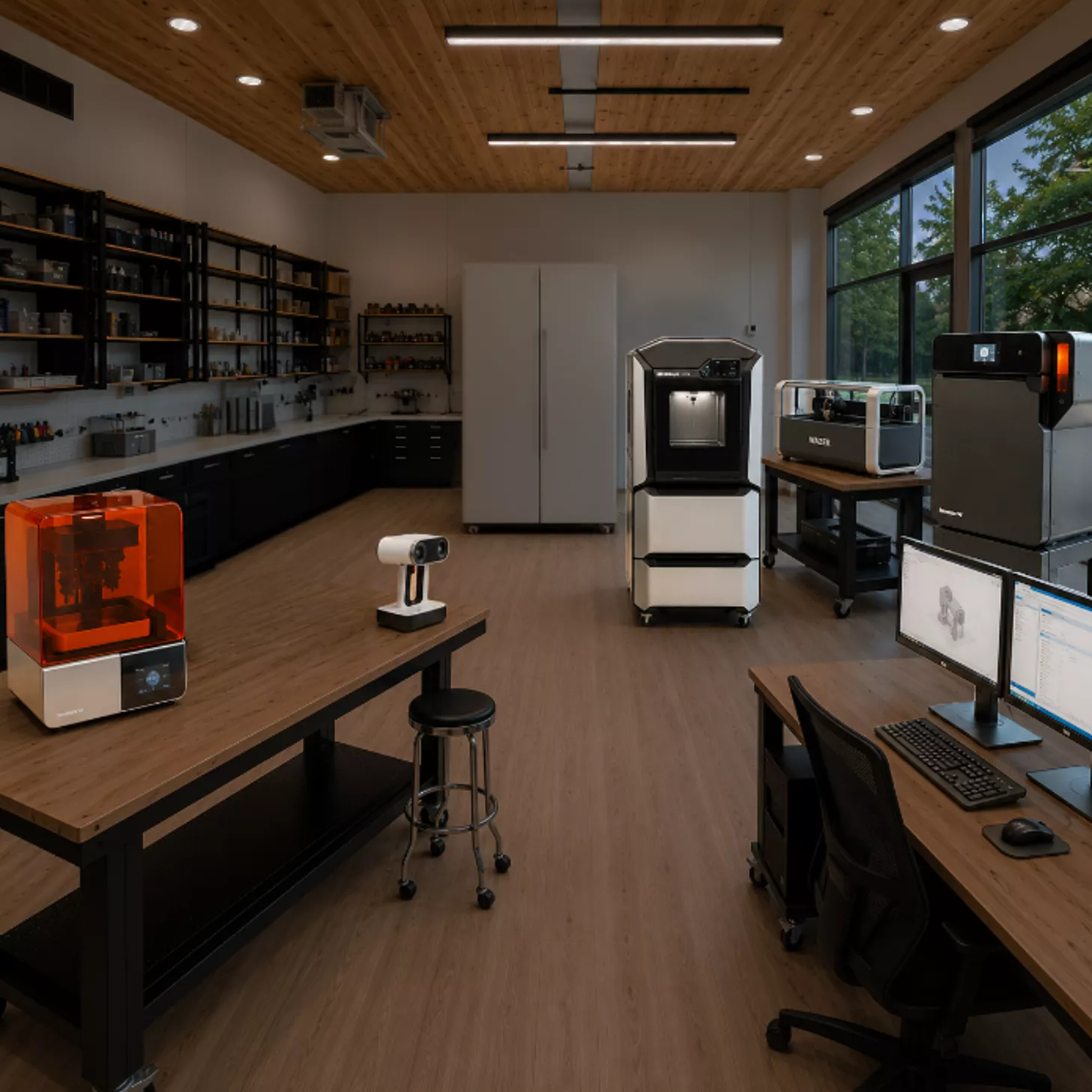
Once the foundational workflow is established, the next stage of evolution involves diversifying the types of materials students can work with and introducing more complex manufacturing methods. The Growth Makerspace moves beyond basic prototyping into high-resolution finishes, production-ready nylon, and reverse engineering.
Continued Design Excellence: SOLIDWORKS EDU CAD
As projects become more complex, the depth of SOLIDWORKS remains constant. In the Growth Makerspace stage, students begin utilizing more advanced simulation and documentation features, moving from simple parts to complex mechanical assemblies.
Industrial-Grade Prototyping: Stratasys FDM
The Tier 2 lab continues to rely on Stratasys FDM technology for its reliable industrial thermoplastic prototyping. This ensures that as the lab grows, the foundational capability of producing durable, functional parts remains robust and accessible to all students.
High-Resolution Resin: Formlabs SLA Resin Printers
Stereolithography (SLA) printing introduces students to the world of liquid resins. Formlabs SLA 3D printers offer high-resolution finishes and a wide array of specialized materials. This technology is essential for projects requiring intricate details and smooth surface finishes that FDM cannot achieve.
Production-Ready Nylon: Formlabs Fuse 1 SLS Printer
Selective Laser Sintering (SLS) has traditionally been used for high-end industrial facilities. However, the inclusion of the Formlabs Fuse 1 in a Growth Makerspace brings SLS to the classroom. This technology uses a laser to sinter powdered nylon, creating parts that do not require support structures. This allows for total geometric freedom and the production of functional, “first-time-right” parts that are ready for production-level testing.
Precision Subtractive Fabrication: WAZER Desktop Waterjet
In the Growth Makerspace, the WAZER continues to serve as the primary subtractive tool, allowing students to cut metal, glass, stone, and composites with a compact desktop system. Its versatility is unmatched for students who need to move beyond plastics and into heavy-duty material fabrication.
Digital Capture: Artec Leo Scanner
To bridge the gap between existing physical objects and digital design, the Artec Leo is introduced. This wireless, handheld 3D scanner features a built-in touchscreen and provides real-time scanning. It is an essential tool for teaching students the fundamentals of reverse engineering and quality inspection workflows.
Tier 3: The Complete Makerspace
Full-Spectrum Manufacturing and Metal LPBF
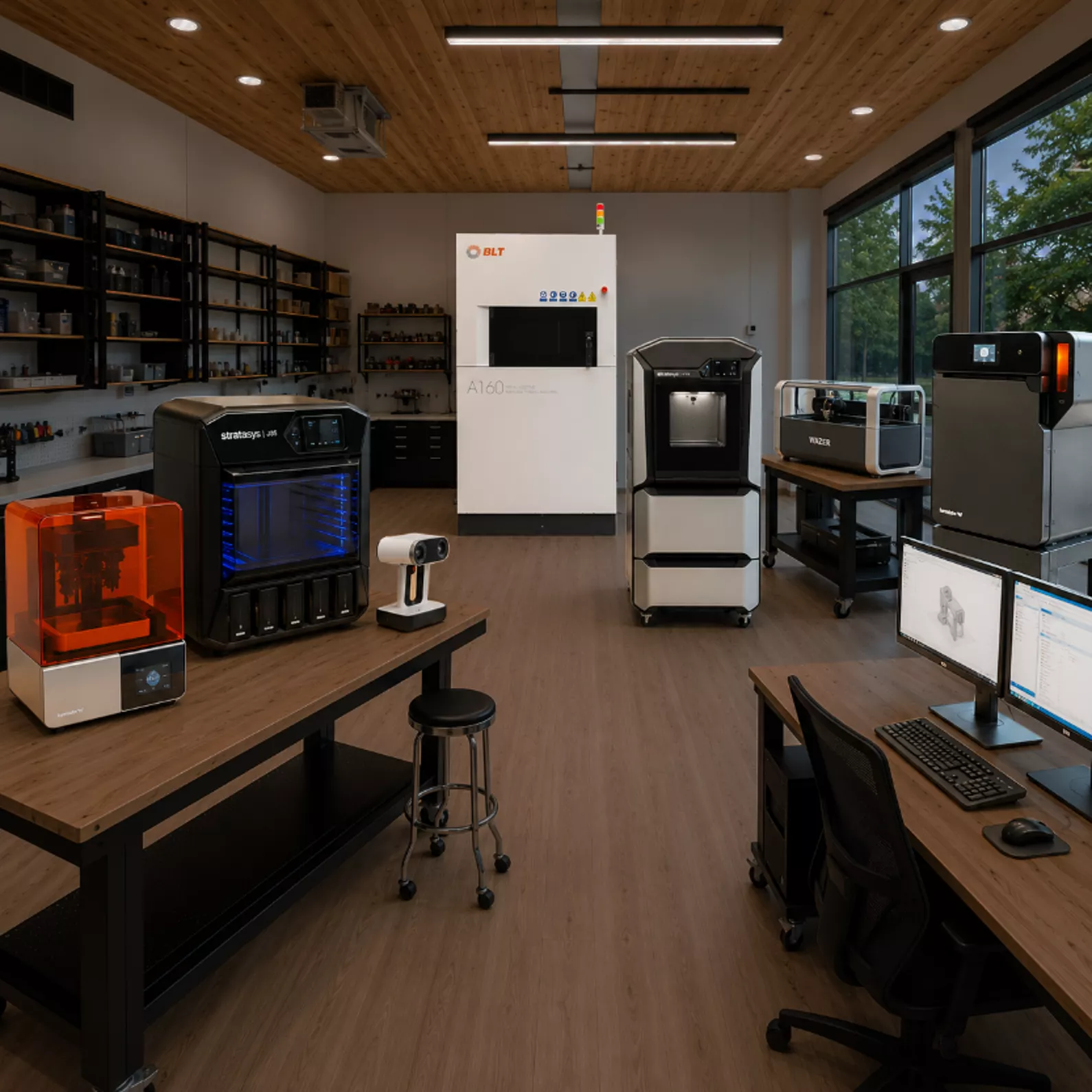
The Complete Makerspace is designed for high-level research, industry partnerships, and professional certification programs. This tier provides full-spectrum capability, allowing students to move from a digital concept to a finished product in almost any material, including industrial-grade metals and multi-material composites.
Professional Engineering Hub: SOLIDWORKS EDU CAD
In this makerspace, SOLIDWORKS serves as the full-stack hub for professional engineering design and documentation. Students at this level are often managing full product lifecycles, using the software to integrate design, simulation, and manufacturing data.
High-Volume Prototyping: Stratasys FDM
Even in the most advanced labs, Stratasys FDM remains the workhorse for reliable industrial thermoplastic prototyping and production. It provides the durability needed for the rigorous testing required in advanced engineering projects.
Specialized Resin Fabrication: Formlabs SLA
Formlabs SLA printers continue to provide the smooth finishes and engineering-grade materials necessary for high-precision components and complex molds in the advanced lab.
Support-Free Nylon Production: Formlabs Fuse 1 SLS
The Formlabs Fuse 1 provides the support-free nylon production capability essential for complex geometries that are impossible with other additive methods.
Multi-Material Innovation: Stratasys PolyJet
At the advanced level, the ability to print in multiple materials simultaneously is a game-changer. Stratasys PolyJet technology allows students to create parts with varying colors, textures, and shore hardness in a single build. This allows for the creation of prototypes that look and feel like finished consumer products, including rubber-like overmolds.
Industrial Metal Printing: BLT A160 Metal LPBF Printer
The ultimate capability of a makerspace is the transition to metal. The BLT A160 Metal LPBF (Laser Powder Bed Fusion) printer brings industrial metal part production to the institution. This system allows for the creation of high-strength components from materials such as stainless steel and aluminum, mirroring the capabilities of modern industrial manufacturing.
Industrial-Scale Subtractive Cutting: WAZER Desktop Waterjet
The WAZER remains the foundational subtractive tool in the advanced lab, providing the ability to cut virtually any material, from stone to composites, to complement the additive technologies.
Advanced Metrology: Artec Leo 3D Scanner
The Artec Leo provides the advanced 3D scanning capability needed for high-level reverse engineering and precision quality inspection. Its wireless, handheld nature makes it versatile for scanning everything from small components to full-scale student-built vehicles.
The GoEngineer Advantage: More Than Just Hardware
Building a world-class EDU lab requires more than just filling a room with equipment. To ensure long-term success, educational institutions need a partner that understands the unique needs of academia:
When you partner with GoEngineer, you can more than just hardware. You get:
- EDU Discount Pricing: We ensure that institutions can maximize their budgets through specialized EDU pricing on both hardware and software.
- Curriculum & Materials: Beyond the machines, we provide the materials and resources needed to integrate these technologies directly into the classroom curriculum.
- Engineering Support: GoEngineer provides the technical expertise and support necessary to keep the lab running, ensuring that students spend their time innovating rather than dealing with technical downtime.
By following this tiered approach, educational institutions can build makerspaces that are not only impressive on paper but are functional, scalable, and deeply impactful for student development. Whether you are starting with a single FDM printer or building a world-class metal fabrication facility, the goal remains the same: empowering the next generation of engineers to design and build the future.
Related Articles
Why Industrial Additive Certification is the Ultimate Student Placement Multiplier
How AAKRUTI Innovation Competition Is Shaping the Next Generation of Engineers
SOLIDWORKS 2026 in the Classroom: How AI-Driven Design Frees Up Your Office Hours
Teach Engineering Effortlessly with 3DEXPERIENCE Education Platform Tools

About GoEngineer
GoEngineer delivers software, technology, and expertise that enable companies to unlock design innovation and deliver better products faster. With more than 40 years of experience and tens of thousands of customers in high tech, medical, machine design, energy and other industries, GoEngineer provides best-in-class design solutions from SOLIDWORKS CAD, Stratasys 3D printing, Creaform & Artec 3D scanning, CAMWorks, PLM, and more
Get our wide array of technical resources delivered right to your inbox.
Unsubscribe at any time.