AI in CATIA: Intelligent CAD Tools and Virtual Engineering Companions

Table of Contents
Artificial intelligence is one of the biggest topics in engineering and manufacturing. So, what does AI mean for CATIA users? The goal of AI is not to replace the engineer, but to let them spend less time on repetitive tasks and searching for information, and more time solving engineering problems.
The AI capabilities built into the 3DEXPERIENCE platform help engineers increase productivity by automating certain functions, and the virtual assistants provide answers and can even perform tedious tasks.
Important NOTE
Some of the AI capabilities discussed in this article are still in beta and under evaluation, so no support is provided, and they may not be included in the next software release. It is strongly recommended that you do not test these features on actual projects. Features in beta will be noted.
AI Built Into 3DEXPERIENCE CATIA
Most of these capabilities are part of the CATIA Mechanical and Shape Engineer role (2026x) and can be accessed through the new Part Design Plus and Generative Shape Design Plus apps.

These are not available in previous versions of 3DEXPERIENCE CATIA, nor in CATIA V5. These AI features are based on AI trained on thousands of models and techniques drawn from over 40 years of CAD data.
Command Intelligence: AI will predict the best command to use based on best practices and then offer those up in the selection-sensitive menu. The commands update based on your selections. This speeds up the design process as it minimizes mouse movements and time searching for commands.
Generative Assembly (Beta): AI will recognize mechanical interfaces of arbitrary parts placed in an assembly. These interfaces enable automatic creation of engineering constraints between parts and establish semantic relationships, allowing the assembly to basically be built automatically.
Generative Tolerancing: This functionality has been around for a few years, but with AI, mechanical interfaces are now automatically recognized. This allows an automatic function to fully develop the datums and GD&T schema for your model. You get a standards-compliant GD&T layout that adheres to ASME Y14.5 standards utilizing your default settings in the user preferences.
Generative Sketch Constraints: Auto Constraint in sketches has existed for some time, but it hasn't always yielded positive results, leading to limited use by users. Starting with 2025x, Dassault Systèmes uses AI to deliver better results with the Auto Constraint command. This has been further improved in 3DEXPERIENCE CATIA 2026x, producing clean and accurate constraints. This functionality is available in any role with sketcher.
Generative Shape Convergence: This has been available since 2025x and is a MODSIM capability. There were two prior methods of optimizing model geometry based on FEA loading requirements. The old-school method was to run an FEA, modify the part, run FEA again, then modify the part, and so on. The other method was topology optimization (sometimes referred to as “generative design”), which let you set the boundary conditions and loads, and a simulation-automatic design adjustment loop would iterate the model until the design fulfilled your requirements, like lightest weight or volume. The result of this latter process produces an organic, mesh-based geometry that would require rework for manufacturing (unless it was strictly for 3D printing). The new Generative Shape Convergence app enables topology optimization without the old-school “organic” mesh-to-CAD conversion step, by directly producing a fully parametric model that is ready to manufacture at every iteration.
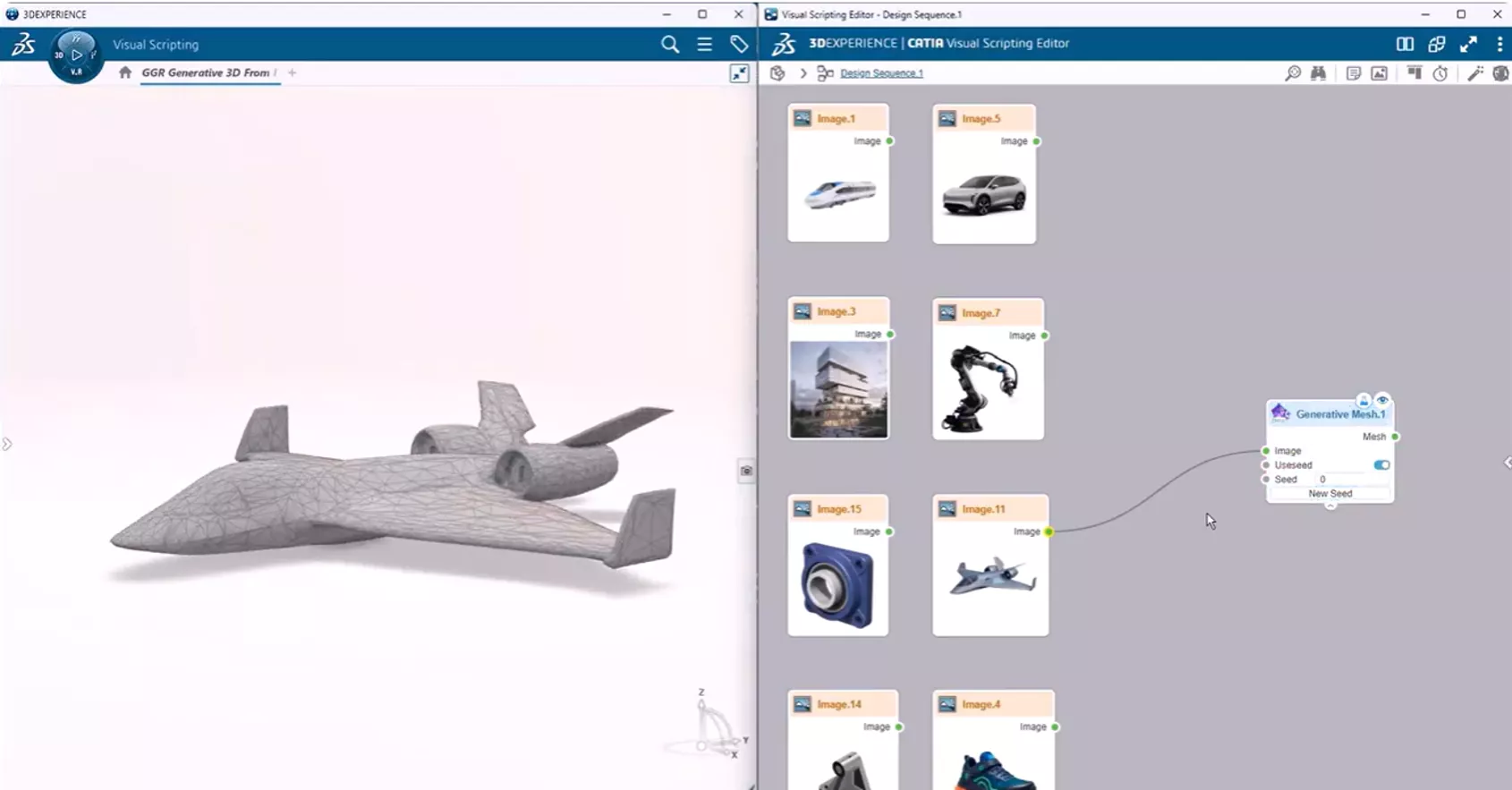
Generative Mesh from Image (Beta): This feature is part of the Visual Scripting app. You can upload one or multiple 2D images or sketches of a model, and the AI in Visual Scripting will generate a 3D mesh based on your input. Currently in beta, this capability allows you to create up to 10 models per day using this technology.
3DEXPERIENCE Virtual Companions
AURA, LEO, and MARIE are three virtual AI companions on the 3DEXPERIENCE platform available to assist users in various areas. These are not generic AI agents, but agents specific to Dassault Systèmes that have been trained on 40+ years of industry expertise and models. They'll help you perform many tasks in a conversational format and are available in 3DEXPERIENCE 2026x.
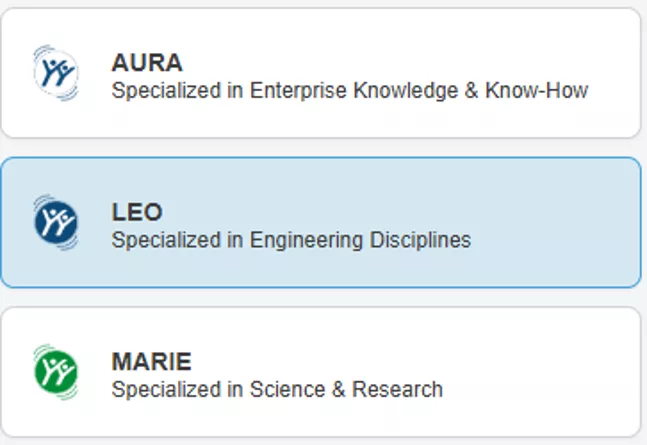
AURA is focused primarily on business and enterprise knowledge, helping users find and understand information contained within the 3DEXPERIENCE environment. You can also implement company standards and documentation for it to reference. As examples, AURA can be used to:
- Find existing information
- Summarize information
- Answer questions using enterprise knowledge
- Assist users with 3DEXPERIENCE applications
- Create content
- Generate reports
- Translate information
- Help manage communities and conversations
- Provide project and product management assistance
LEO is an engineering-focused companion that can work directly with models and processes and can perform tasks in your engineering workflow. Some examples of tasks LEO can assist with:
- 3D navigation
- Design insight
- Parametric design
- Product structures
- Material assignment
- Product structure generation
- Design review
- Assembly design
- Part generation
- Mechanical interface prediction
- Assembly generation
- Drafting
- Functional tolerance generation
- Knowledge-based engineering
- Template instantiation
MARIE is the scientist of the group. Although it is not specifically a CATIA design assistant, it is important in the overall 3DEXPERIENCE platform and workflow. It is directed at BIOVIA users for scientific workflows. Here are some of MARIE’s capabilities:
- Scientific experiment authoring
- Scientific data analysis
- Molecular model creation and editing
- Scientific pipeline execution
- Regulatory content
- Quality data analysis
Requirements for AI in CATIA
Cloud Services: The newest Virtual Companion capabilities are delivered through the 3DEXPERIENCE platform cloud environment. If you have 3DEXPERIENCE CATIA on the public cloud (rather than on-premise), you have this.
Version: The virtual companions and most AI capabilities became available in version 2026x of 3DEXPERIENCE CATIA.
CATIA Roles: Virtual companions are available via the 3DSwym app, but the AI built into the CATIA software is only available in certain roles. Mechanical and Shape Engineer will include most of what we discussed.
Blue Tokens: The virtual companions consume Blue Tokens during use. These tokens are made available to customers running the 3DEXPERIENCE platform on the public cloud. Eligible customers will get a pool of tokens allocated to them for testing and experimenting with the AI companion capabilities. Consumption of tokens will vary based on task complexity. Additional token packs can be purchased after the initial token pack allotment is depleted.
Conclusion
AI in CATIA is rapidly improving, but the goal is not to replace engineers. It is to make them more efficient, hopefully getting products to market faster. You will see AI not only in 3DEXPERIENCE DESIGN, but across the entire product lifecycle. Companions and automation can greatly enhance the design process, but these are new capabilities, so it is important to be diligent in checking what these tools are producing. In the meantime, enjoy exploring their capabilities and think about how they can help your organization.
Related Articles
The Hidden Cost of Late Engineering Changes: $5 M for 15 mm
Celebrating Fibonacci Day with Visual Scripting
3DEXPERIENCE CATIA Springback and Warp Compensation CAD Models
Easily Design Part Families Using a Spreadsheet in 3DEXPERIENCE CATIA

About Joel Quizon
Joel Quizon is the CATIA Product Manager at GoEngineer. He earned his Mechanical Engineering degree from the University of Colorado, is a Certified SOLIDWORKS Mechanical Design Expert, and has over 30 years of experience in the CAD industry.
Get our wide array of technical resources delivered right to your inbox.
Unsubscribe at any time.