Fatigue of an SAE 1045 Steel Hook Under a 125 kN Load with SIMULIA Durability and Mechanics Engineer

Table of Contents
Traditional structural validation typically relies on static linear analysis, often overlooking critical inertial nuances of real-world operation. This study compares the durability of an SAE 1045 steel hook under a 125 kN cyclic load, showing how SIMULIA Durability and Mechanics Engineer (accessible through 3DEXPERIENCE STRUCTURAL) fundamentally improve fatigue-life predictions.
By transitioning from a static baseline to an Implicit Dynamic procedure, we move beyond "aggressive" loading assumptions to capture a high-fidelity durability profile. Utilizing the Brown-Miller multiaxial algorithm with Morrow mean-stress corrections, we pinpoint failure risks that standard yield-based methods miss. This "precision sizing" framework lets engineers maintain strict regulatory compliance while minimizing in-service risk and the high costs of over-engineering.
In heavy-duty lifting operations, structural failure is rarely the result of a single, catastrophic overload. Instead, the primary threat is Fatigue, the progressive and localized structural damage that occurs when a material is subjected to cyclic loading. While a Static Linear check can confirm that a hook resists a 125 kN load without yielding, it offers a "snapshot" in time that fails to account for the cumulative damage, load sequences, and peak variations experienced over thousands of operational cycles.
The Challenge of Dynamic Environments
The engineering challenge lies in the discrepancy between idealized static models and the reality of the field. A hook’s operational life is defined by:
- Intensity Variations: Fluctuating loads that create a complex stress history.
- Inertial Effects: The mass of the hook and the load itself, which introduce dynamic forces that static solvers ignore.
- Gravitational Influence: A constant factor that becomes critical when calculating the true equation of motion in dynamic simulations.
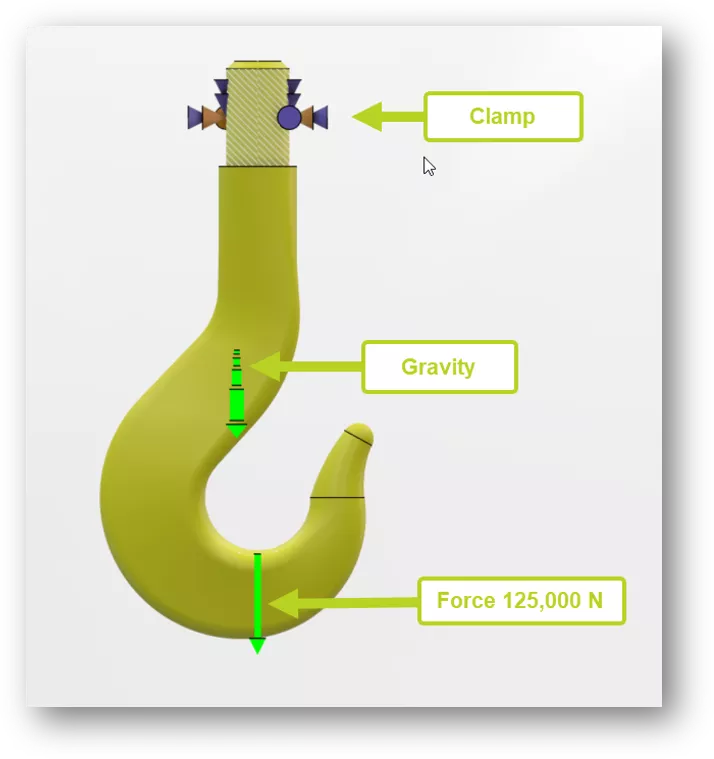
Using the fatigue and durability capabilities within 3DEXPERIENCE STRUCTURAL simulation, we simulated a 125 kN force applied to the hook’s base, with a fixed "clamp" condition at the shank. By incorporating gravity and time-domain effects into the Implicit Dynamic model, we aim to demonstrate how accounting for the physics of motion can lead to a radically different and more accurate prediction of structural durability compared to a purely static approach.
Description of the analysis and assumptions
The model uses the full hook geometry, with particular attention to small-radius areas known to concentrate stress. The material is SAE 1045 steel, described by its usual mechanical properties (E, ν, Rp0.2, Rm) and an S-N curve from the Simulia Durability material database.
Two based procedures are considered in this study:
Procedure 1 (Static Linear Analysis): 125 kN force and gravity.
Procedure 2 (Implicit Dynamic Analysis): 125 kN force that reaches its peak at 0.002 s.
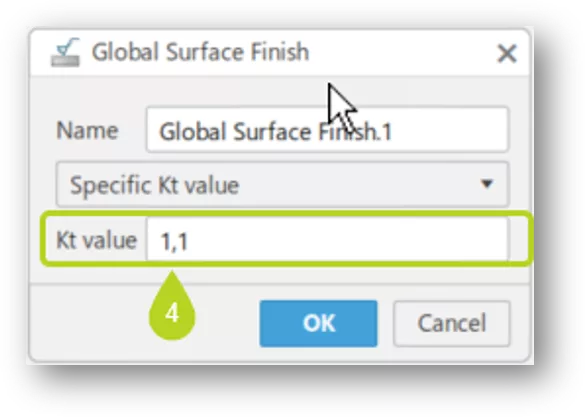
A surface condition factor is included via a specific Kt = 1.1 set in Global Surface Finish.
To accurately predict the service life of the SAE 1045 steel hook, the durability analysis utilizes a strain-based Finite Life approach, specifically optimized for ductile metals subjected to cyclic loading.
At the core of the simulation is the Brown-Miller algorithm, a multiaxial critical-plane criterion that evaluates both maximum shear and normal strain to capture crack initiation in the hook's high-stress zones.
To account for real-world gravitational effects and non-zero mean stresses, the Morrow correction is applied, refining the strain-life curve to reflect how tensile mean stresses accelerate fatigue.
Finally, a fatigue endurance limit is established at 20 million reversals (2Nf), providing a clear threshold for infinite life performance.
By combining these advanced parameters, the study moves beyond simple yield-strength checks to provide a high-fidelity estimation of the hook’s true operational longevity.
Model preparation (SOLIDWORKS / 3DEXPERIENCE)
To ensure a seamless engineering workflow, the 3D CAD model of the hook was developed and refined in SOLIDWORKS, leveraging its robust parametric design capabilities. The transition from design to high-fidelity simulation is managed via the 3DEXPERIENCE Collaborative Designer for SOLIDWORKS.

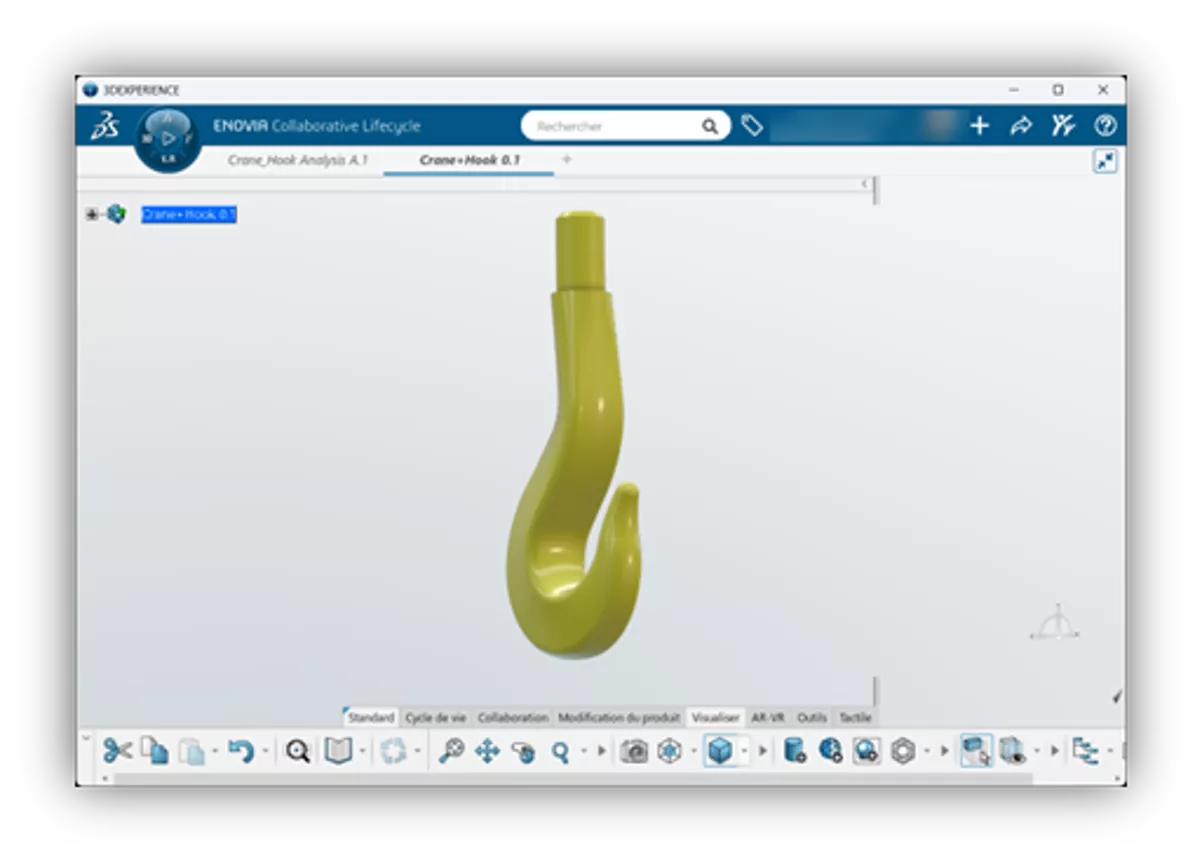
This specialized connector enables fully transparent data transfers, maintaining a single source of truth, where any geometric modifications made in SOLIDWORKS are automatically synchronized with the SIMULIA simulation environment. By eliminating manual file exports (such as STEP or IGES), this integrated pipeline ensures the fatigue analysis always reflects the most current design iteration, significantly reducing the risk of data loss and accelerating the optimization loop.
Steps to run the fatigue analysis
To initiate the durability simulation, navigate to the Durability tab and select Create Durability Case. This step creates a specialized computational container that establishes a direct link between the structural FEA results and the fatigue solver.

Create a durability case.

Set the specific Kt value in Global Surface Finish (Kt is a corrective factor used in fatigue calculations to account for surface roughness effects on life; Kt = 1.1 is typical for a large-radius hook with a smooth profile).
Add an event or create fatigue loading.

Add a Sequence of Frames load event. By using a Sequence of Frames, the solver calculates fatigue life based on the direct extraction of stress and strain results from each time increment of the base FEA. This is particularly useful for non-linear or implicit dynamic analyses, where the multiaxial stress state continuously evolves and cannot be simply scaled, capturing the true time-varying nature of the full duty cycle.
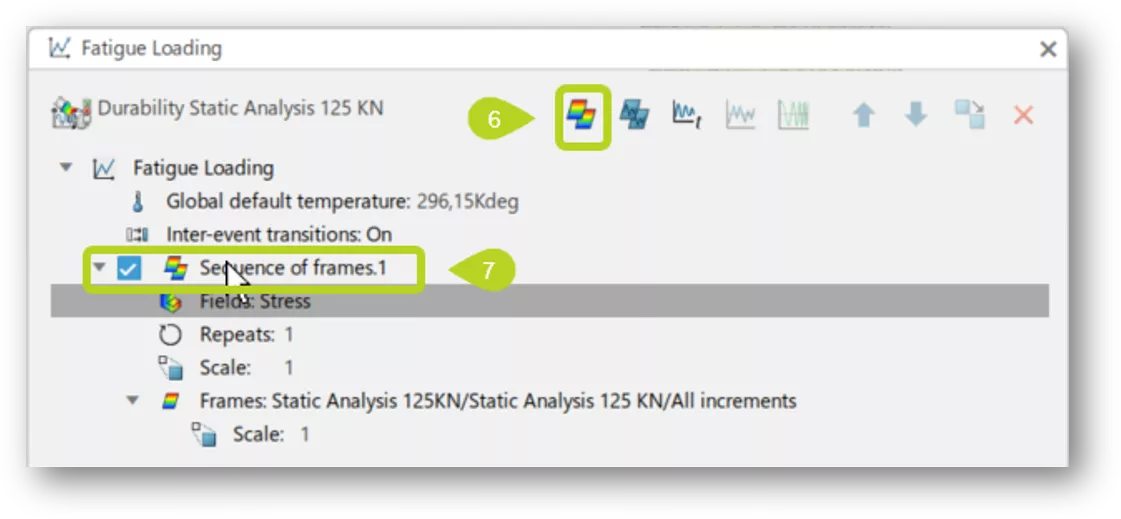
The frames and increment identify the Source Data. It tells the fatigue solver exactly which result file and time step to use as the stress reference.
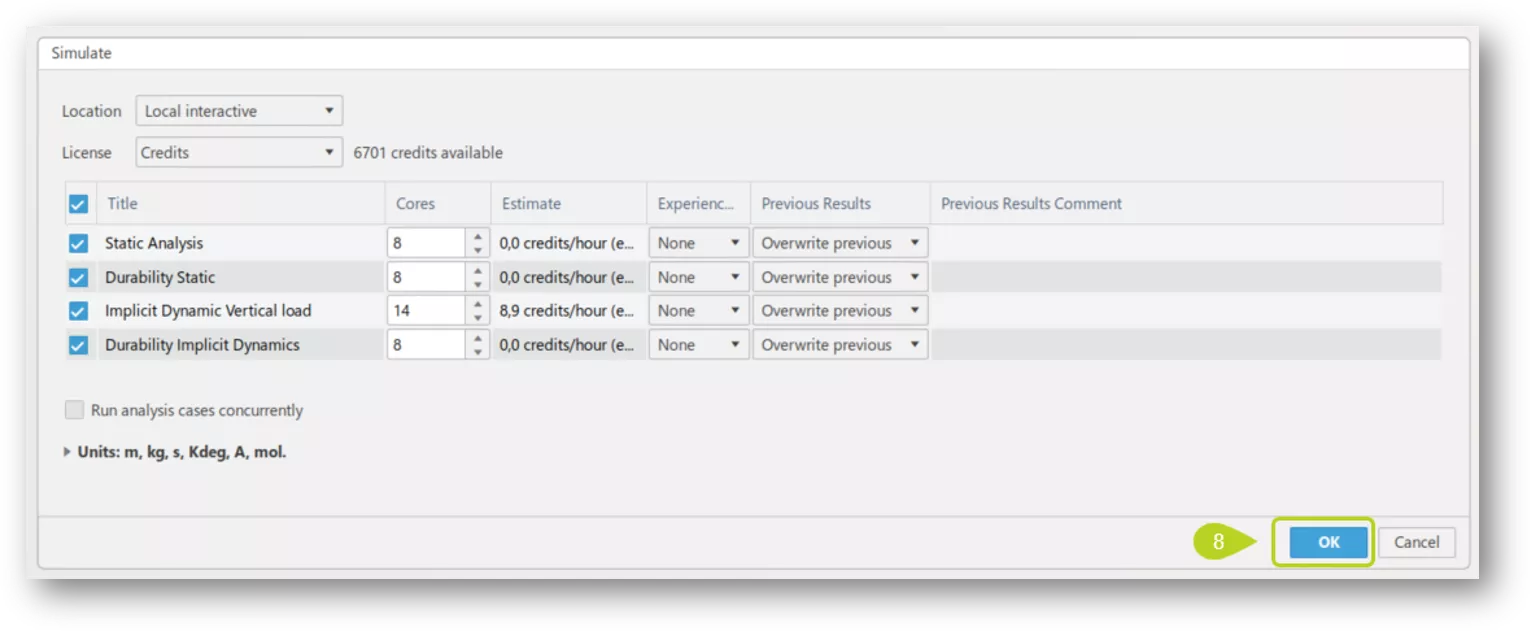
Go to the Simulate tab and run the fatigue analysis.
Results
Comparative Analysis: Static Overestimation vs. Dynamic Reality
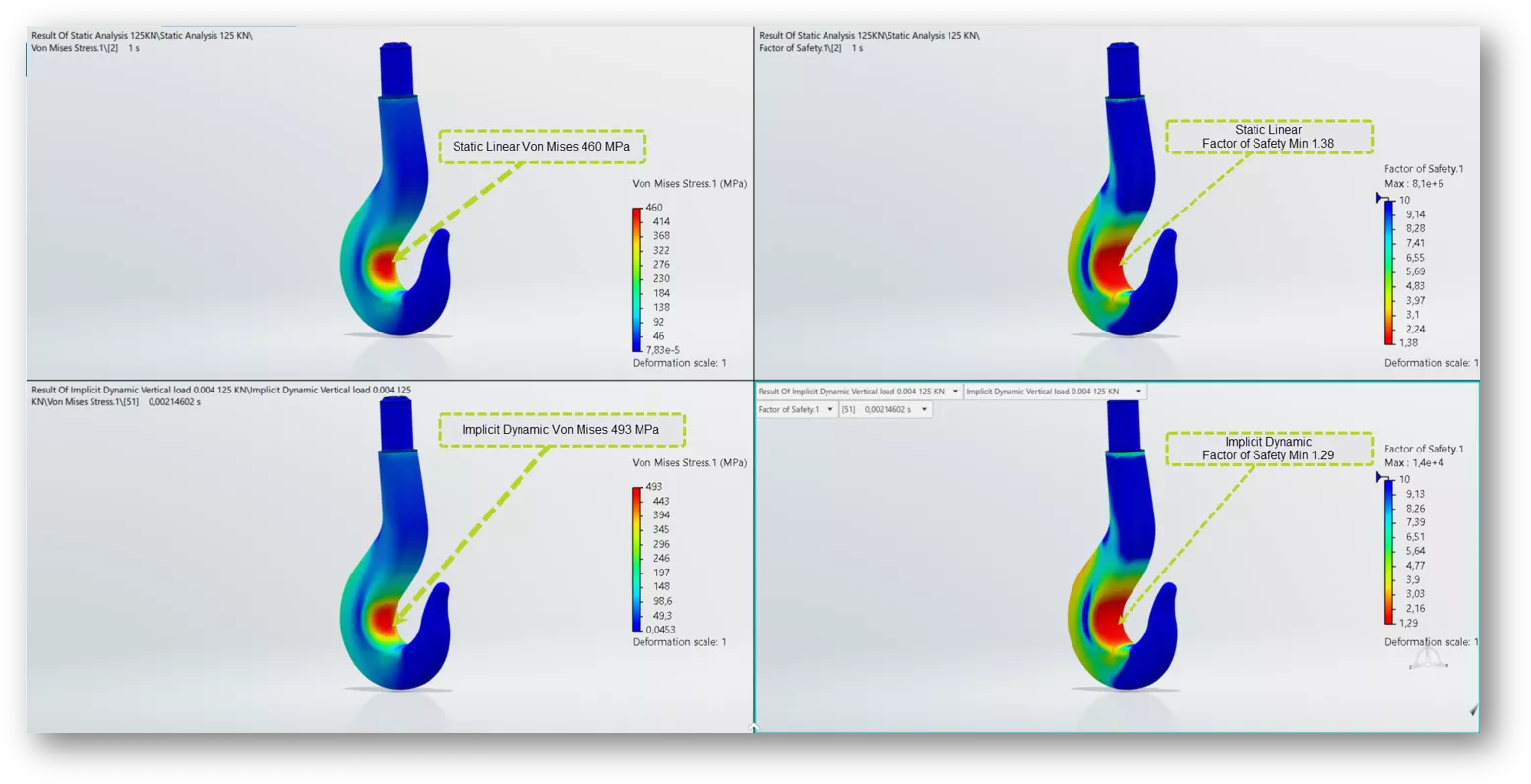
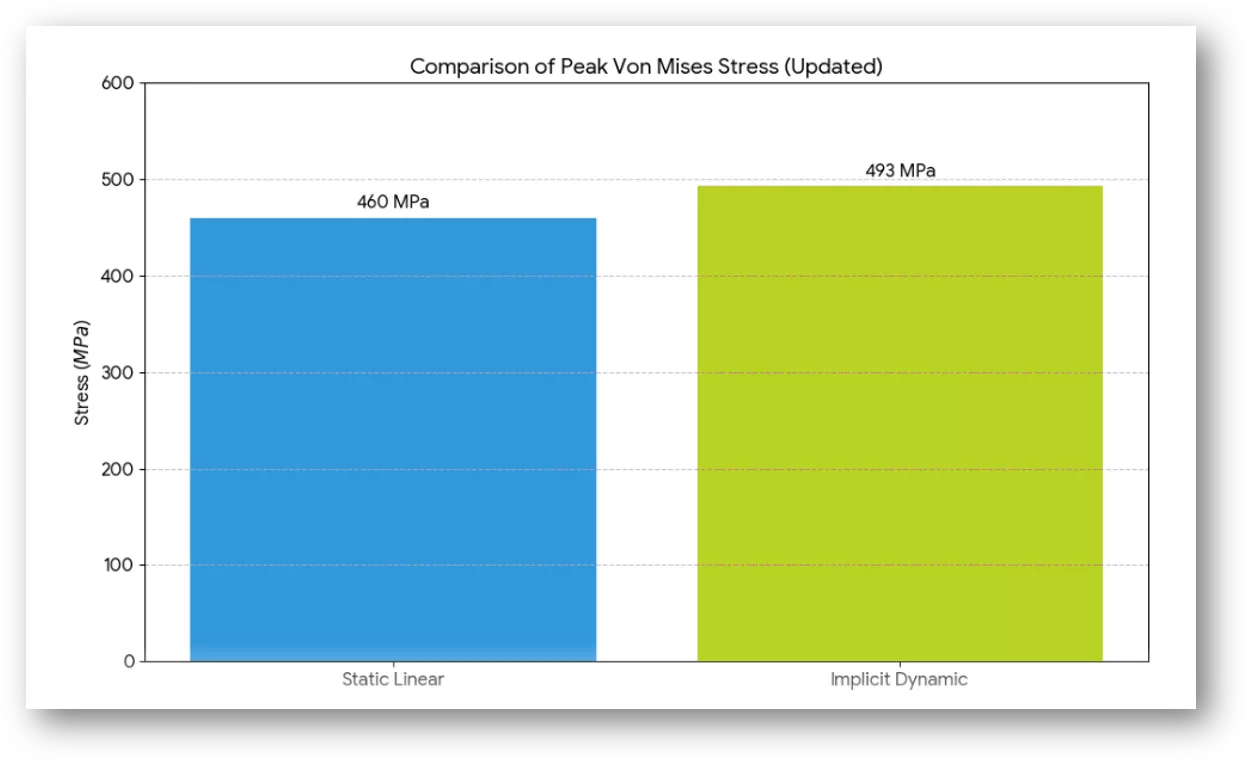
Comparing simulation methodologies reveals a critical insight: Static Linear analysis predicts a Von Mises stress of 460 MPa (FoS 1.38), while an Implicit Dynamic analysis (t = 0.002 s) captures the true peak stress of 493 MPa (FoS 1.29) for SAE 1045 steel.
This 7.2% stress increase is vital for accurate durability prediction. When processed through the Brown-Miller algorithm with Morrow mean-stress correction, these dynamic loads demonstrate that a static approach under a 125 kN load is artificially optimistic. Accounting for time-dependent mass effects enables high-precision sizing that captures true peak stresses and prevents unexpected fatigue failures.
Critical Plane Damage Vector and Log of Life (Cycle Numbers)
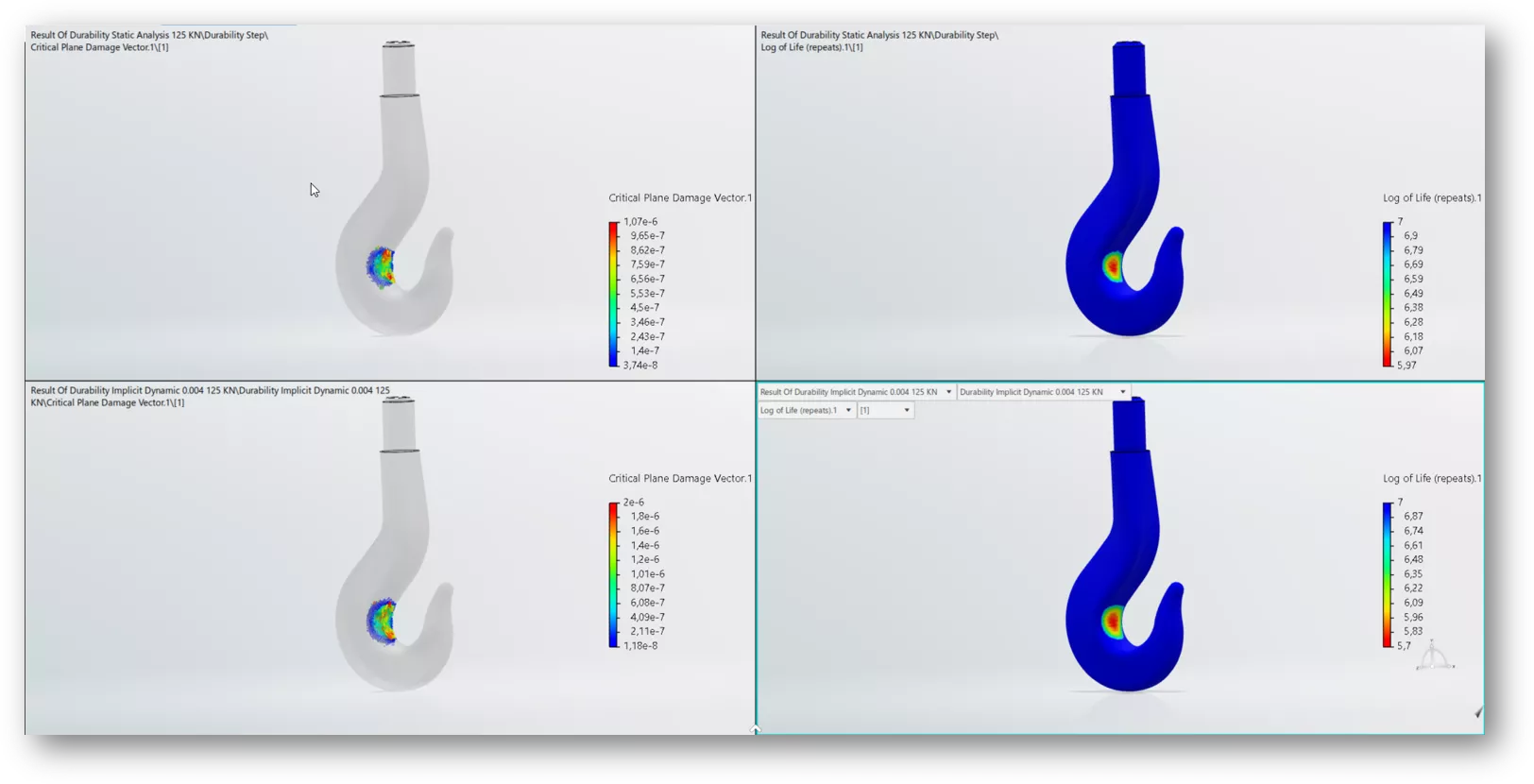
The comparative durability results clearly illustrate the limitations of a purely static approach when evaluating the SAE 1045 lifting hook.
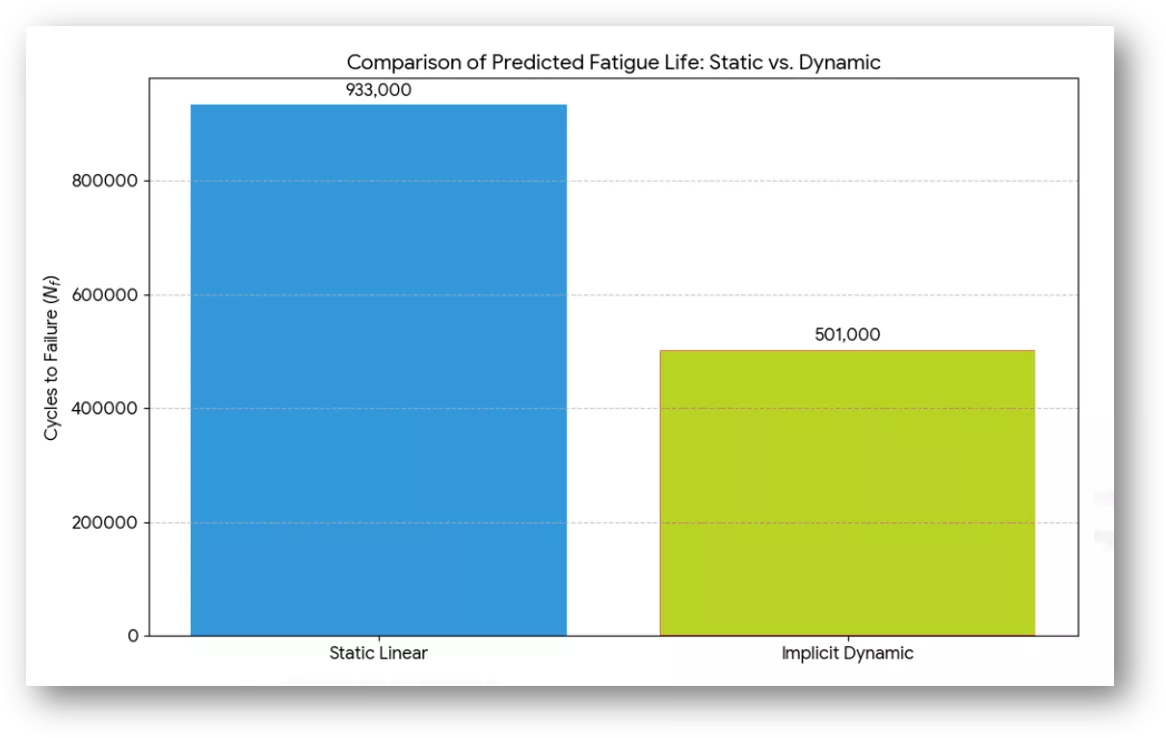
In the static linear analysis, the Critical Plane Damage Vector predicts a maximum damage of 1.07e-6 per cycle, corresponding to a Log of Life of 5.97, or 933,000 cycles. However, when the 125 kN load is applied as an implicit dynamic event, capturing the structural inertia at t = 0.002 s, the damage vector nearly doubles to 2.0e-6.
Processed through the Brown-Miller multiaxial algorithm, this increased damage drastically reduces the predicted fatigue life to a Log of 5.7, or approximately 501,000 cycles. The highly localized red zones on the inner radius confirm that while the primary site of crack initiation remains consistent, the intensity of the combined shear and normal strains is severely underestimated by the static solver.
Conclusion
The stark contrast between static assumptions and dynamic reality proves that "good enough" simulation is no longer a viable strategy for high-performance components. By leveraging the Durability and Mechanics Engineer simulation role on the 3DEXPERIENCE platform, we move beyond the limitations of linear analysis to capture the true physics of inertial loading. This study demonstrates that a modest 7.2% increase in nominal stress identified only through implicit dynamic simulation translates into a massive 46% reduction in predicted fatigue life.
With these durability tools, engineers can transform complex stress states into actionable insights, utilizing the Brown-Miller multiaxial algorithm to pinpoint the exact rate of damage accumulation on the critical plane. This transition from static over-engineering to dynamic precision sizing is more than a technical upgrade; it is a competitive advantage.
Questions?
If you have any questions or would like to learn more about simulation, please contact us.
Related Articles
Approximation Models in SIMULIA Isight for Reduced Order Modeling
When to Move from Linear to Nonlinear Finite Element Analysis
Advancing Engineering Simplicity: SIMULIA’s New Unified Licensing Model

About Hanitra Jonarivelo
Hanitra Jonarivelo has over 20 years of experience in Structural and Fluid Dynamics Simulation. Throughout his career, he has provided engineering technology solutions to various industries including Consumer Products, Mining, Medical, Energy, HVAC, and High tech where he cultivated strong relationships with enterprise clients. Hanitra has worked with a diverse range of Simulation software and technologies, including SIMULIA, Abaqus, and SOLIDWORKS Simulation.
Get our wide array of technical resources delivered right to your inbox.
Unsubscribe at any time.