How Canadian Tier 2 & Tier 3 Suppliers Can Secure Contracts Under the $2B GDLS Expansion

The Canadian defence manufacturing landscape reached a pivotal turning point with the announcement of a $2 billion contract awarded to General Dynamics Land Systems-Canada (GDLS-Canada). This award expands the Armoured Combat Support Vehicle (ACSV) platform by 190 units, along with an additional 35 units designated for international assistance, bringing the total production run to 550 vehicles built on the LAV 6.0 chassis.
This contract represents the first operational execution of Canada’s Defence Industrial Strategy (DIS) and its Build-Partner-Buy framework. All 190 vehicles must be engineered, fabricated, and assembled domestically at GDLS-Canada’s primary facility in London, Ontario. The production cycle spans from 2027 to 2030 and relies on a cross-country supply chain of over 600 Canadian suppliers spanning more than 100 communities.
 For Canadian Tier 2 and Tier 3 manufacturers, machine shops, and component fabricators, this liquidity injection creates an unprecedented multi-year opportunity.
However, prime contractors cannot afford delivery delays or quality failures. To win and sustain subcontracts under this framework, suppliers must address four core operational requirements:
- Fulfill Industrial and Technological Benefits (ITB) direct local content mandates.
- Ensure strict data security in accordance with Controlled Goods and CPCSC cybersecurity standards.
- Eliminate quality control bottlenecks and streamline First-Article Inspection (FAI).
- Reduce tooling lead times using production-grade composite and metal additive manufacturing.
Below is a breakdown of how Canadian suppliers can scale their workflows, meet regulatory requirements, and modernize their shop floors with integrated engineering solutions.
#1. Fulfilling Local Content & ITB Requirements
Under Canada’s updated Defence Industrial Strategy, the federal government enforces strict compliance with the Industrial and Technological Benefits (ITB) Policy. Unlike past procurement models, where foreign primes could satisfy ITB commitments through indirect investments or unrelated commercial offsets, current guidelines mandate direct work allocated to Canadian-based small and medium enterprises (SMEs) and domestic suppliers.
For GDLS-Canada and Tier 1 systems integrators, meeting ITB obligations requires transferring detailed manufacturing packages to domestic Tier 2 and Tier 3 suppliers.
However, accepting complex defence assemblies introduces distinct engineering friction points for subcontractors:
- Handling Mixed File Formats: Prime contractors often release native CATIA or 3DEXPERIENCE data, whereas regional machine shops frequently standardize on SOLIDWORKS 3D CAD or third-party CAM packages.
- Managing Engineering Change Orders (ECOs): Revision control errors on complex vehicle subassemblies, such as hull mounting brackets, powerpack enclosures, or suspension arms, can result in scrap parts and assembly line stoppages.
- Digital Thread Continuity: Subcontractors must maintain full traceability from initial 3D design to the shop floor toolpath and final inspection report.
Bridging Design & Manufacturing
SOLIDWORKS & the 3DEXPERIENCE Platform
To scale engineering output without exponentially increasing headcount, Canadian suppliers need seamless CAD interoperability and centralized data management.
By integrating SOLIDWORKS 3D CAD with the cloud-native 3DEXPERIENCE platform, Tier 2 and Tier 3 vendors can open, inspect, and modify native CATIA and neutral CAD geometries without file translation errors or lost model history.
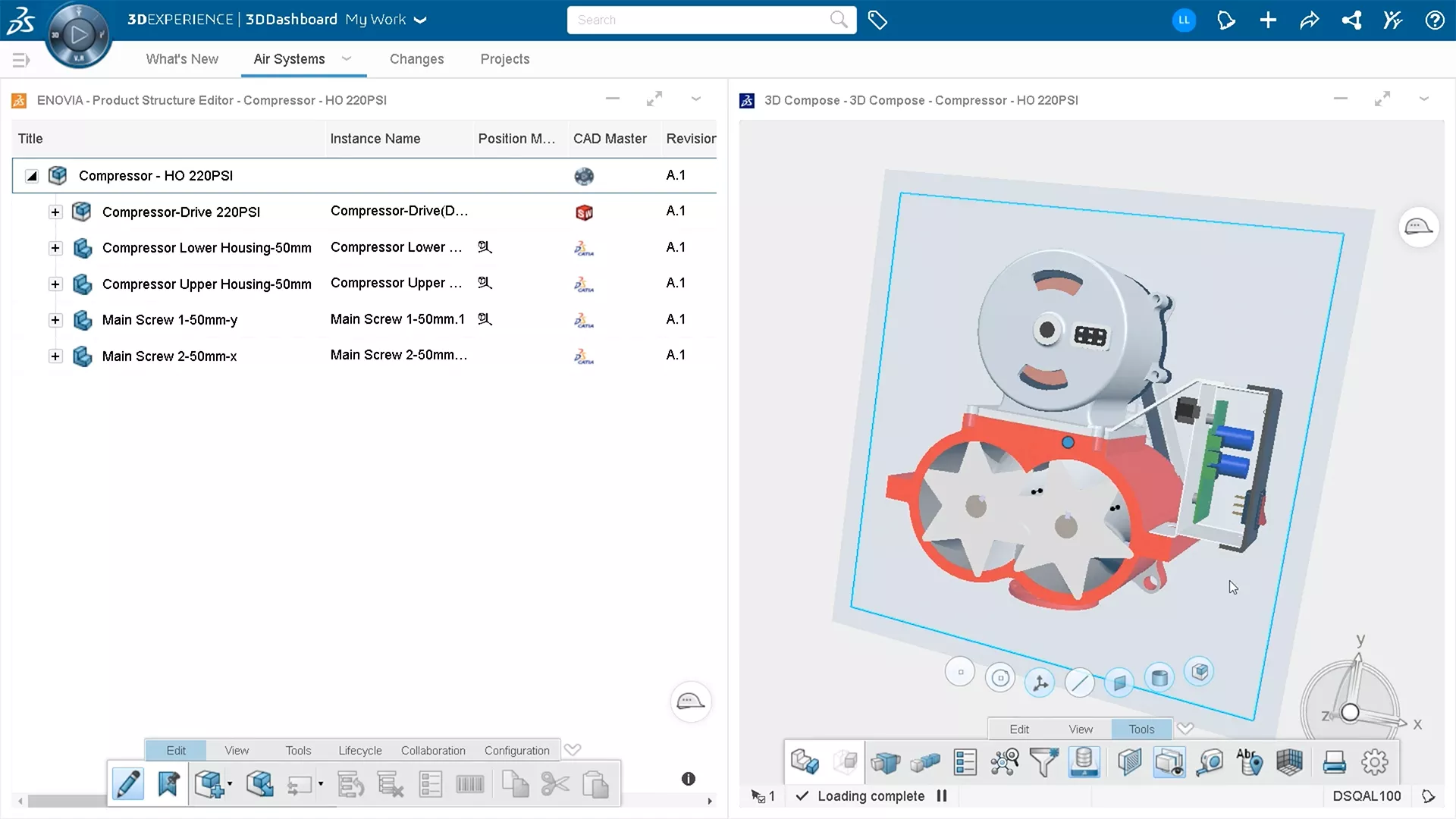
Multi-disciplinary teams can collaborate on complex assemblies in real time, validating spatial clearances, mechanical fits, and weight targets long before physical metal is cut.
When engineering changes occur, associative link mechanisms ensure that downstream manufacturing assets, including CNC toolpaths, sheet metal flat patterns, and quality inspection programs, update automatically. This eliminates manual rework, reduces engineering change lead times, and provides primes with clear evidence of a structured, ITB-compliant engineering operation.
#2. Navigating Security and Compliance
Participating in Canadian defence supply chains requires navigating strict regulatory frameworks. Handling technical data for military platforms like the LAV 6.0 ACSV subjects suppliers to two mandatory compliance thresholds:
- Controlled Goods Program (CGP): Managed under Canada’s Defence Production Act, CGP mandates strict access controls, physical security, and digital data governance for any entity examining, possessing, or transferring controlled defence items or technical data.
- Canadian Program for Cyber Security Certification (CPCSC): Phased directly into Department of National Defence (DND) procurements, CPCSC establishes mandatory cybersecurity hygiene levels for contractor networks to prevent industrial espionage and cyber threats.
A common failure mode for commercial suppliers transitioning to defence subcontracts is reliance on unencrypted file transfers, consumer cloud drives, or unmanaged network shares to exchange CAD models and technical drawings. Exposing controlled defence data to unauthorized access carries severe legal penalties, contract termination, and disqualification from future bids.
Securing Intellectual Property
ENOVIA (3DEXPERIENCE) and SOLIDWORKS PDM
To satisfy CGP and CPCSC mandates without crippling daily engineering productivity, suppliers must embed security directly into their Product Data Management (PDM) and Product Lifecycle Management (PLM) infrastructure.
SOLIDWORKS PDM Professional
For local or hybrid network architectures, SOLIDWORKS PDM Professional provides centralized file vaulting, automated revision control, and granular, role-based access to permissions. Technical parameters can be configured to restrict access to controlled files strictly to CGP-cleared personnel:
- Role-Based Folder & File Permissions: Restrict document access based on employee security clearance, project role, and physical location.
- Automated Audit Trails: Track every file check-out, modification, export, and approval step with detailed timestamped logging.
- Controlled Export Controls: Prevent unauthorized copying, printing, or exporting critical CAD files and manufacturing drawings.
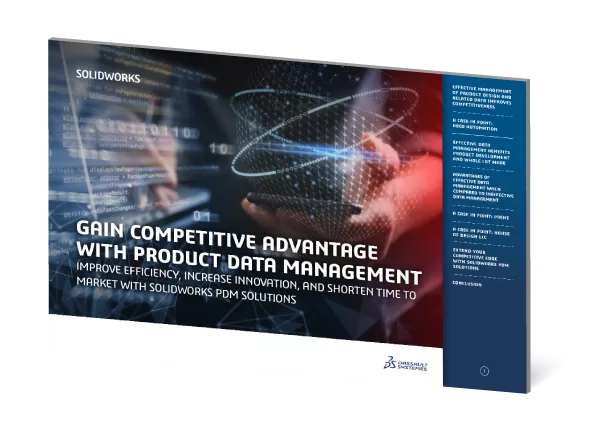
Gain Competitive Advantage with Product Data Management
Once viewed as valuable to only design and engineering groups, product design and related data have become the essential fuel to power product development efforts. Today, all key stakeholders play a role in design collaboration, so having the right technology that enables product data to be easily found, secured, and shared is vitally important.
ENOVIA on the 3DEXPERIENCE Platform
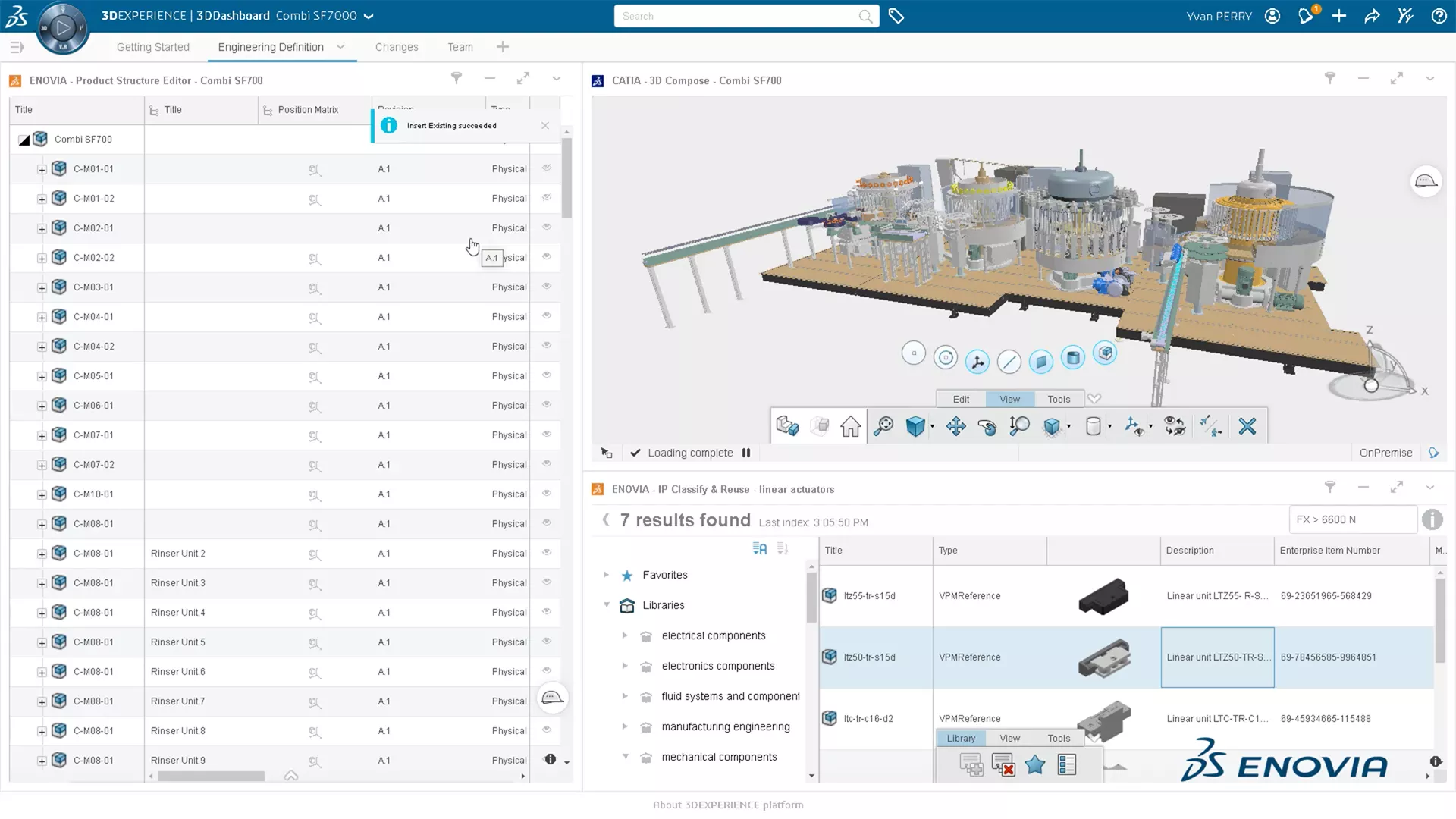
For distributed engineering teams or multi-site organizations, 3DEXPERIENCE CLOUD PLM (also known as ENOVIA) extends secure PLM capabilities to cloud environments. It provides a single source of truth for Bills of Materials (BOMs), engineering changes, and supplier communications while maintaining strict alignment with CPCSC cyber standards:
- Encrypted Data Storage & Transit: Built on enterprise-grade encryption architectures designed to meet defence data isolation requirements.
- CGP Access Rules & IP Security: Define data classification tags so that foreign subsidiaries, unvetted contractors, or unauthorized personnel cannot view or download controlled geometry.
- Integrated CAD-to-BOM Traceability: Maintain complete historical records linking initial design intent, engineering change requests (ECRs), and final shop-floor manufacturing instructions.
By deploying pre-configured PDM and PLM templates, Canadian suppliers can present prime contractors with immediate proof of digital compliance, shortening the security audit phase during subcontract negotiations.
#3. Modernizing Quality Control & First-Article Inspection
Quality assurance in defence manufacturing is non-negotiable. Components manufactured for armored vehicles must withstand extreme structural loads, ballistic impacts, and harsh environment operating conditions. Consequently, prime contractors require rigorous First-Article Inspection (FAI) documentation compliant with AS9100 or ISO 9001 standards.
Traditional quality control methods, such as manual height gauges, calipers, or tactile Coordinate Measuring Machines (CMMs), present significant operational bottlenecks for Tier 2 and Tier 3 machine shops:
- CMM Capacity Limits: Fixed CMMs are slow to program, sensitive to shop floor vibration, and limited by probe reach when measuring complex curved surfaces or large structural weldments.
- Incomplete Surface Data: Discrete point probing can miss localized surface deviations, warpage, or wall thickness variations across complex castings, press-formed armor plate, or long fabrications.
- Inspection Delays: Waiting for CMM availability halts production setups, creating idle machine time and delaying part approvals.
Accelerating FAI Workflows
Handheld Artec 3D Scanners
To overcome measurement bottlenecks and maintain shop floor throughput, leading manufacturers are incorporating 3D optical metrology directly into their quality control workflows. Portable, handheld optical scanners, such as the Artec Leo and Artec Eva, enable rapid, non-contact 3D surface capture on the shop floor.
Artec Leo: Wireless, On-Site Metrology
The Artec Leo is a fully wireless, self-contained 3D scanner featuring built-in onboard processing and a real-time touchscreen display.
- Shop-Floor Portability: Because it requires no external computer or trailing cables, quality inspectors can carry the scanner directly inside vehicle hulls, onto large machining centers, or across multi-station welding cells.
- Speed and Resolution: Capturing up to 35 frames per second with 3D point accuracy up to 0.1 mm, the Leo rapidly captures complex geometries, deep pockets, and heavy structural weldments in minutes.
Artec Eva: Versatile Precision Scanning
The Artec Eva utilizes structured light technology to capture medium-to-large objects with high textured detail and dimensional accuracy, making it ideal for inspecting engine bay components, sheet metal brackets, and molded rubber or composite ducting.
Closed-Loop Inspection & CAD-to-Part Comparison
Using Artec Studio software, physical scan data captured by the Artec Leo or Eva is aligned directly against the nominal 3D CAD reference model. The software generates colour-coded 3D surface deviation maps that instantly highlight out-of-tolerance conditions, thermal distortion from welding, or tool wear trends.
| Inspection Metric | Traditional Tactile CMM | Artec Handheld Optical Scanning |
| Setup Time | High (requires dedicated fixtures and probe programming) | Minimal (point-and-shoot calibration and scanning) |
| Data Capture Method |
Discrete point probing (10-100 points) |
Full surface coverage (millions of data points) |
|
Portability |
Fixed room or bulky articulated arm |
Fully portable (Artec Leo operates wire-free) |
|
FAI Report Generation |
Manual data entry/custom scripting |
Automated CAD-to-mesh deviation maps |
|
Shop Floor Integration |
High vulnerability to temperature/vibration |
Resistant to shop floor environmental factors |
By outputting digitally certified FAI reports with full 3D colour maps, suppliers can document part conformity for GDLS-Canada quality auditors before shipping, virtually eliminating receiving dock rejections.
#4. Accelerating Tooling and Production Lead Times with 3D Printing
Machining high-strength armor steel (such as Hardox or Armox alloys), structural aluminum, and specialized defence composites places heavy stress on tooling setups. Machining custom jigs, welding fixtures, soft jaws, and inspection nests out of aluminum or steel blocks consumes valuable CNC spindle hours and raw material, and delays production startups.
To meet aggressive delivery targets under the 2027-2030 ACSV production timeline, Tier 2 and Tier 3 suppliers must look beyond traditional subtractive tooling methods. 3D printing provides a direct path to compress tooling lead times from weeks to hours while freeing up CNC equipment for billable production parts.
High-Strength Composite Tooling
Markforged FX10 & Stratasys
For work-holding fixtures, assembly jigs, and end-of-arm tooling exposed to high mechanical forces, continuous-fiber composite 3D printing offers an alternative to CNC-machined metal tooling.
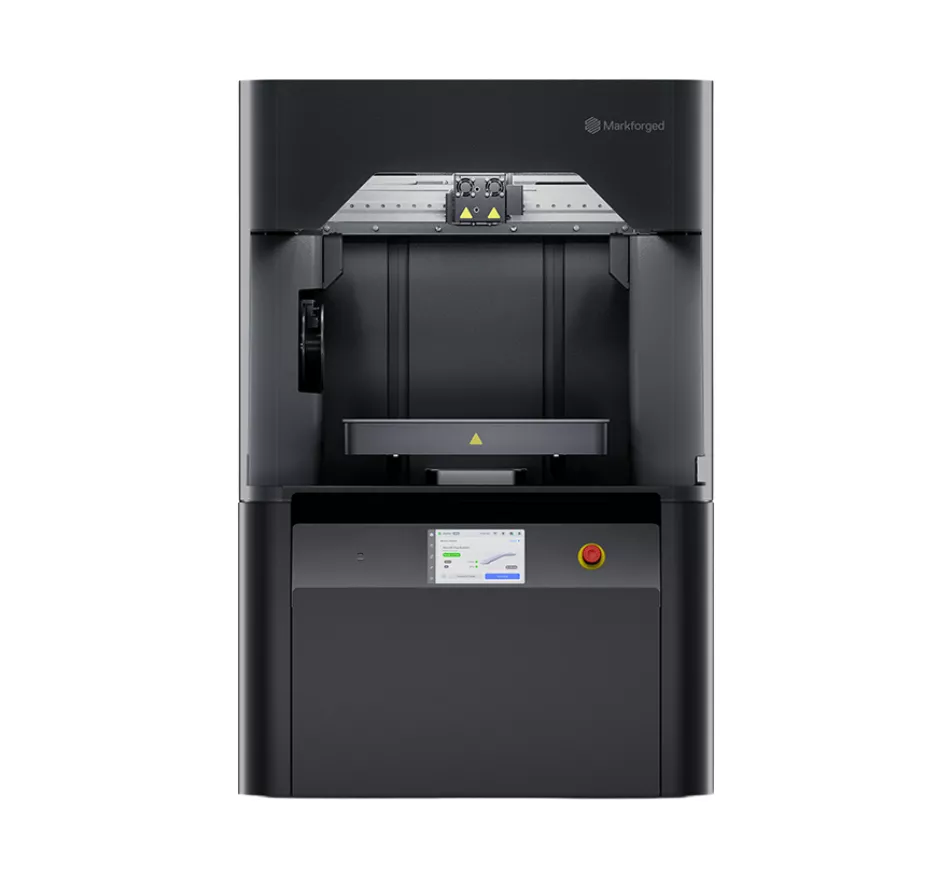
Markforged FX10
Engineered specifically for the factory floor, the Markforged FX10 utilizes Continuous Fiber Reinforcement (CFR) technology, combining matrix materials like Onyx® (micro-carbon fiber-filled nylon) with continuous strands of Carbon Fiber, Kevlar, or Fiberglass).
- Metal-Strength Fixturing: Parts printed on the FX10 with continuous carbon fiber reinforcement achieve high tensile strength and stiffness, matching the mechanical properties of aluminum at a fraction of the weight.
- Integrated Vision System: The FX10 incorporates optical sensors to inspect dimensional accuracy during the print process, ensuring printed tooling meets tight tolerance requirements before installation.
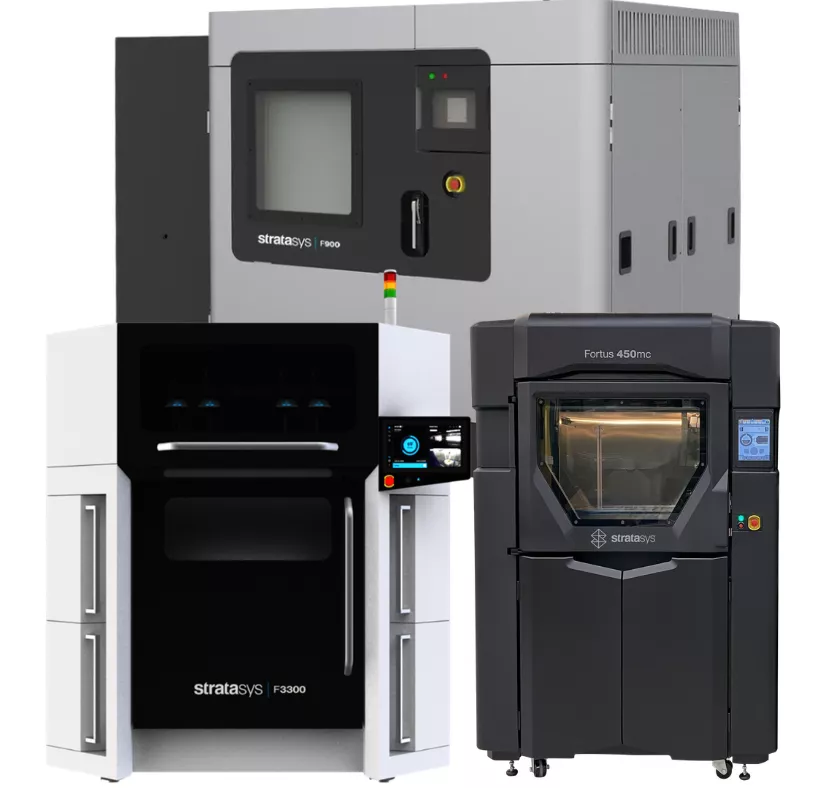
Stratasys FDM Industrial Systems
Stratasys industrial FDM systems utilize high-performance thermoplastics such as ULTEM™ 9085 resin, Nylon 12CF, and Polycarbonate.
- Flame-Retardant and Chemical Resistance: ULTEM™ materials offer high thermal & chemical resistance, and FAR 25.853 flame-retardant certification, making them ideal for specialized engine compartment ducting, electrical enclosures, and high-temperature composite layup tooling.
Direct Metal Production
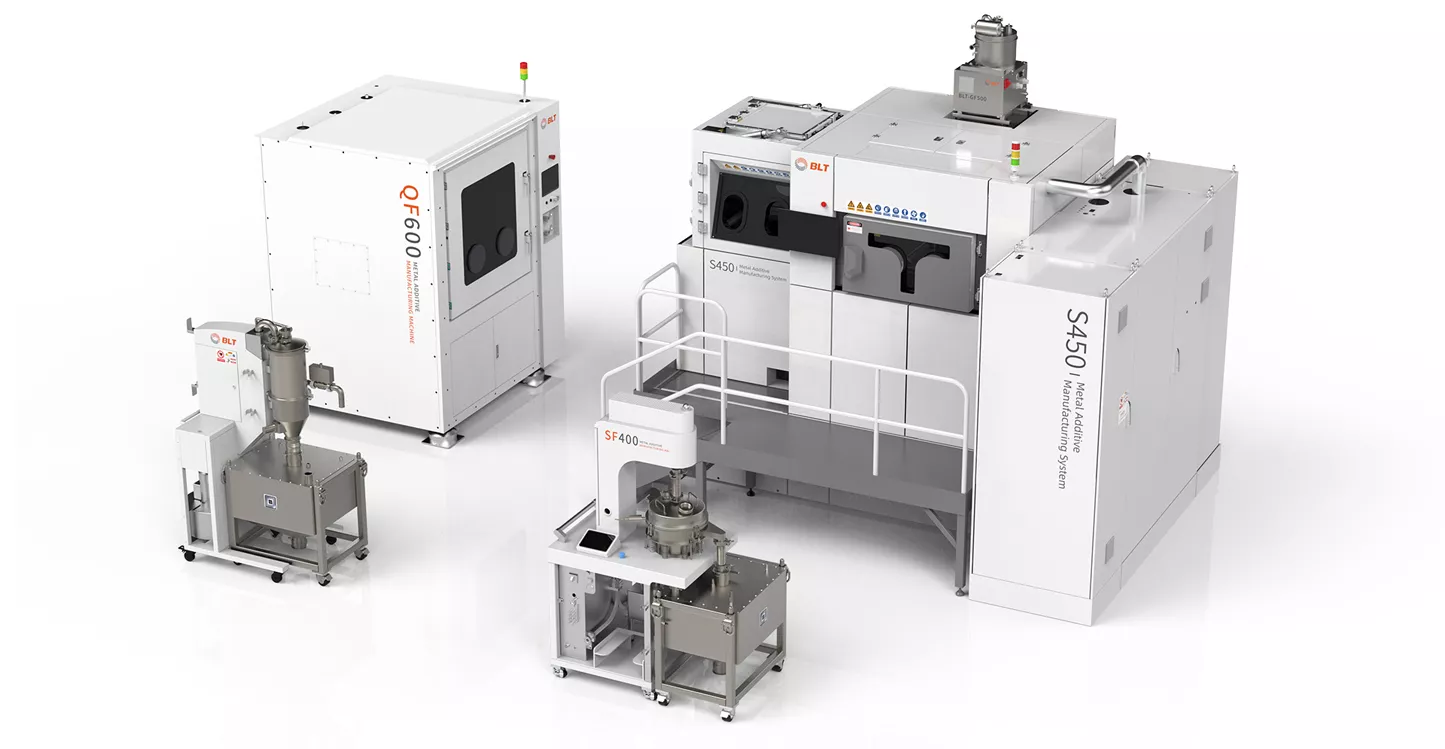
BLT Metal Additive Systems
When application parameters mandate solid metal production parts, specialized brackets, or high-temperature engine mounts, BLT (Bright Laser Technologies) multi-laser Selective Laser Melting (SLM) platforms allow suppliers to print dense metal components directly from 3D CAD files.
Capable of processing aerospace-grade superalloys, including Titanium alloys, Inconel 718, Stainless Steel 316L, and Aluminum F357, BLT systems enable Tier 1 and Tier 2 suppliers to produce complex structural nodes and internal heat exchangers that cannot be produced using standard multi-axis machining.
Core Applications for Additive Manufacturing in Defence Subcontracts
- Modular Welding Fixtures & CMM Nests: Print custom, non-marring holding fixtures contoured to complex curved armor geometries in under 24 hours.
- CNC Soft Jaws & Machining Fixtures: Produce high-durability soft jaws on demand to hold delicate castings or odd-shaped forgings during secondary machining operations.
- Forming & Press Tooling: Utilize continuous carbon fiber tools to form sheet metal brackets, shielding panels, and rubber seals without investing in hard steel tooling dies.
- End-Use Vehicle Components: Manufacture specialized air ducting, wire harness brackets, cable clamps, and interior mounting plates using flame-retardant thermoplastics or metal alloys.
Preparing Your Facility for Defence Subcontracts
Transitioning or scaling up shop floor operations to capture subcontracts under the $2B GDLS expansion requires a structured implementation plan. The following roadmap outlines the key steps to achieve defence readiness:
- Audit Digital Data Workflows and Security Policies
- Audit existing file storage, data sharing, and revision control procedures against Controlled Goods Program (CGP) rules and CPCSC levels.
- Implement structured vaulting using SOLIDWORKS PDM Professional or 3DEXPERIENCE PLM to enforce permission controls and automated audit trails.
- Establish Digital Continuity Between CAD, CAM and Quality
- Ensure your design and CAM software can native-ingest multi-CAD data without translation loss.
- Integrate Artec 3D optical scanners into the quality control process to generate automated CAD-to-part colour maps for First-Article Inspection reports.
- Offload CNC Spindles with Additive Manufacturing
- Identify metal fixtures, soft jaws, and assembly jigs currently scheduled for CNC machining.
- Deploy composite 3D printing platforms like the Markforged FX10 or Stratasys industrial series to print high-strength fixtures overnight, reserving machine shop capacity for high-margin production contracts.
Partnering with GoEngineer
The $2 billion GDLS-Canada expansion represents a major opportunity for Canadian manufacturers to build long-term, high-margin revenue streams under the Defence Industrial Strategy. However, converting this potential into contract wins requires proven engineering software, robust data security, modern 3D quality inspection, and rapid tooling capabilities.
GoEngineer brings deep technical expertise and direct local presence across Canada. Our team helps Tier 2 and Tier 3 suppliers implement turnkey technology stacks, spanning Dassault Systèmes software, Artec 3D scanners, and industrial additive manufacturing hardware from Markforged, Stratasys, and BLT.
Support Across Canada’s Defence Corridors
Navigating military procurement timelines requires fast, local technical support. GoEngineer supports Canadian manufacturers through local offices, hardware demonstration labs, and accredited training centers located directly in key industrial hubs:
- Ontario Manufacturing Corridor: Local facilities in Toronto (Etobicoke) and Cambridge provide hands-on training, technical support, and hardware benchmarking for Southwestern Ontario machine shops and systems integrators.
- Quebec Technology Hub: Our office in Brossard delivers localized bilingual engineering services, simulation consulting, and software support for Quebec’s defence and electro-optics suppliers.
- Western Canada Hub: Located in Calgary, our Western team supports heavy industrial fabricators, precision machining facilities, and energy sector suppliers expanding into defence manufacturing.
Take the Next Step Toward Defence Readiness
To evaluate your engineering workflows, review CGP data security setups, or see a live demonstration, please contact us by filling out the form below.
About GoEngineer
GoEngineer delivers software, technology, and expertise that enable companies to unlock design innovation and deliver better products faster. With more than 40 years of experience and tens of thousands of customers in high tech, medical, machine design, energy and other industries, GoEngineer provides best-in-class design solutions from SOLIDWORKS CAD, Stratasys 3D printing, Creaform & Artec 3D scanning, CAMWorks, PLM, and more
Get our wide array of technical resources delivered right to your inbox.
Unsubscribe at any time.