

Get pricing and a benchmark part
Tell us the system you are evaluating and the part you need to make.
Tell us which machine you are comparing and we will send the head-to-head, a benchmark part, and installed pricing.
5
Additive technologies
27
Stratasys printers
39
Competing systems compared
Start with the technology, then the machine
Most comparisons go wrong because two printers that look alike on a spec sheet are built for different jobs. Pick the process that matches the part you need, then read the head-to-head. Every number below is a published manufacturer specification, and every Stratasys claim is tied to something you can verify on the machine.

FDM
F870
Metre-long thermoplastic parts with soluble support, printed in a 95 °C chamber that holds temperature end to end.

PolyJet
J850 Pro
Rigid, flexible, and clear photopolymers combined in a single build, down to 14 microns.
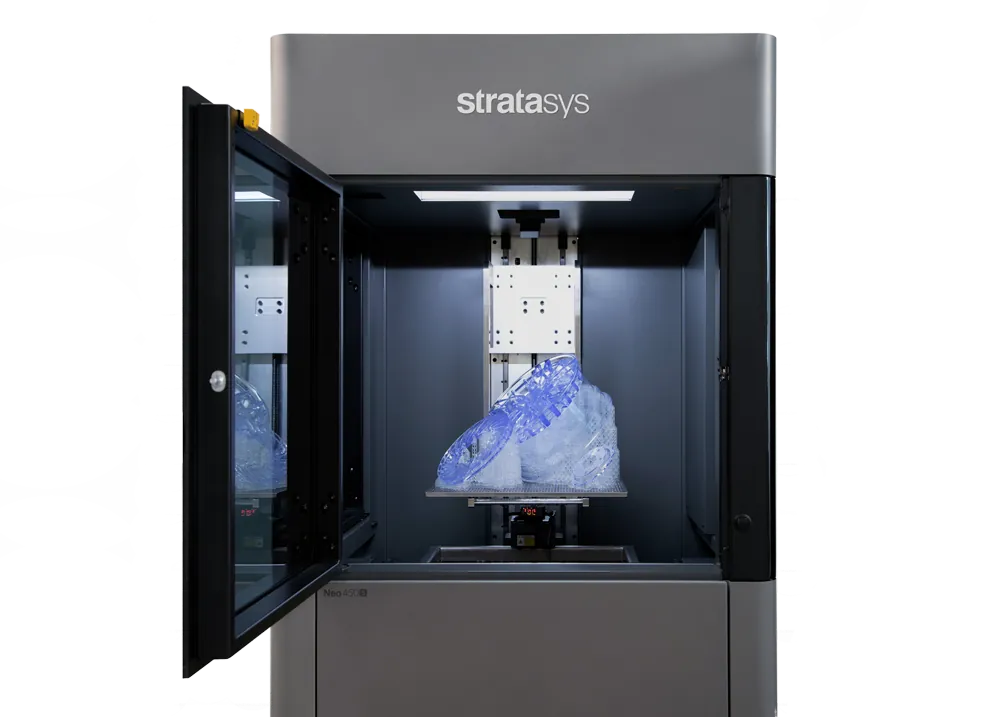
Stereolithography
Neo800+
Large, smooth, dimensionally stable SLA parts on an open 355 nm resin platform you are not locked into.
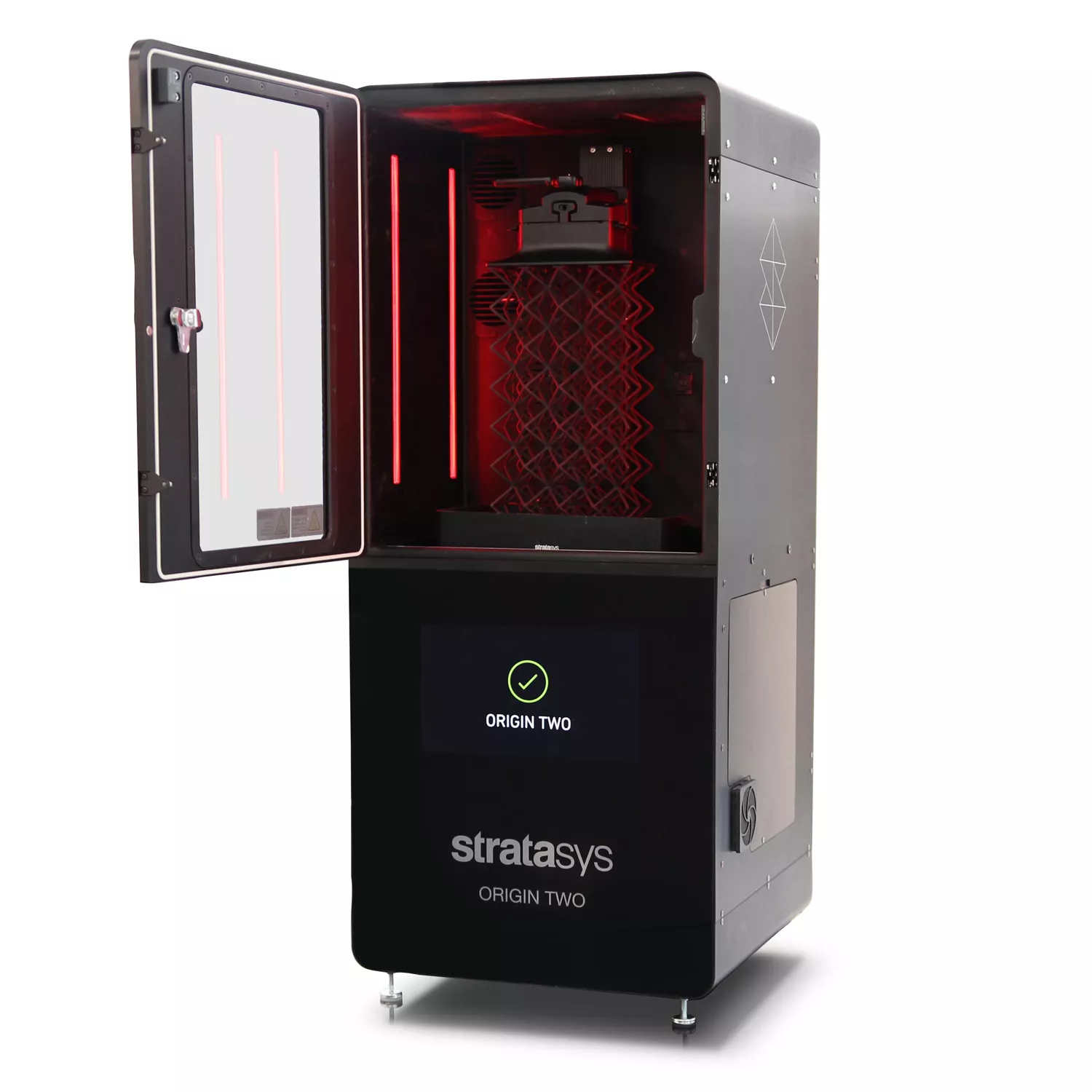
P3
Origin Two
Production photopolymer parts at 38.5 micron pixel resolution, bought outright instead of subscribed to.
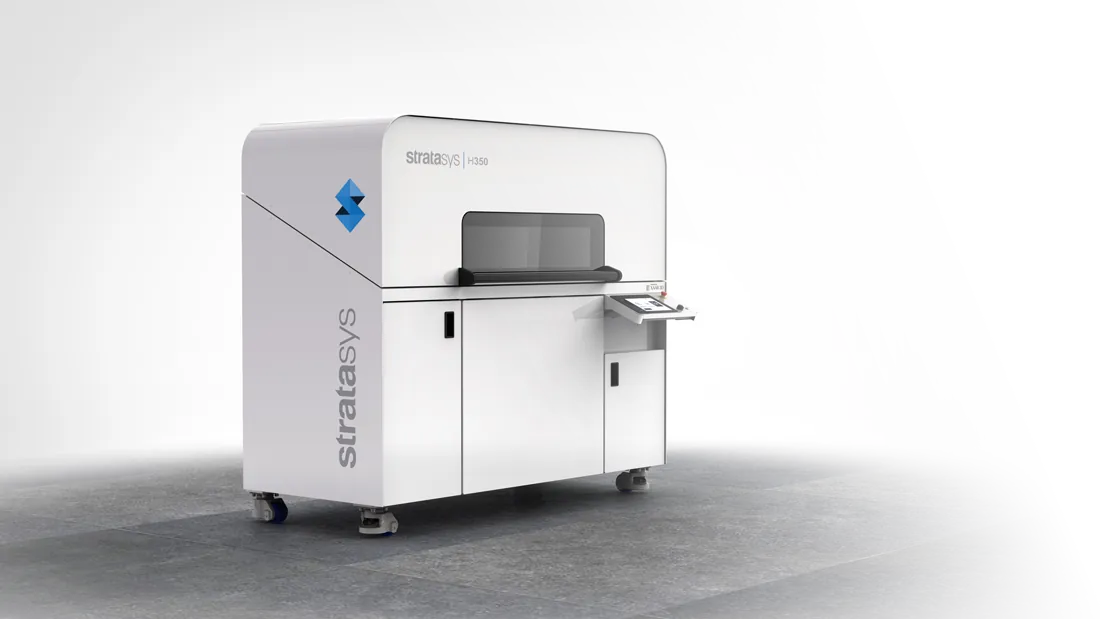
SAF
H350
Short-run production nylon and polypropylene parts with consistent quality from the first part to the last.
FDM: large-format production parts in engineering thermoplastics
FDM is where most competitive shortlists start, and at large format the two machines look alike on the envelope — both are a metre long in X. What separates them is what happens inside the chamber while a part that size is printing.
Stratasys F870
FDM · large format production
- Build size
39.4 × 24.0 × 24.0 in (1000 × 610 × 610 mm) - Layer thickness
0.178 / 0.254 / 0.330 mm - Key capability
95 °C fully heated chamber; N14, N20H, N25 heads - Materials
Nylon 12CF, ASA (6 colors), ABS-M30, ABS Draft
Comparable system
BigRep STUDIO G2
FFF · open filament
- Build size
39.4 × 19.7 × 19.7 in (1000 × 500 × 500 mm) - Layer thickness
0.1 – 0.6 mm - Key capability
Build volume temperature 40 °C max; dual extruder - Materials
ASA, ABS, HI-TEMP CF, PA6/66, PETG, PLA, TPU
Why buy the F870
Choose the F870 for 49% more build volume — 372 litres against 250 — and a 95 °C fully heated chamber against the STUDIO G2's 40 °C maximum. Both machines are a metre long in X. Only one holds temperature while a part that size is printing, which is what keeps the bottom of a tall part the same size as the top.
PolyJet: multi-material prototypes that behave like the product
This comparison is not decided on resolution or tray size. Both machines jet photopolymer at roughly the same layer height, and the ProJet holds the larger tray. What differs is the material library you can combine in a single build.
Stratasys J850 Pro
PolyJet · design and engineering
- Build size
19.3 × 15.4 × 7.9 in (490 × 390 × 200 mm) - Layer thickness
Down to 14 microns - Key capability
Multi-material; full color not included - Materials
Vero, Agilus30, DraftGrey, VeroUltra
Comparable system
3D Systems ProJet MJP 5600
MultiJet · rigid and elastomer blends
- Build size
20.4 × 15.0 × 11.8 in (518 × 381 × 300 mm) - Layer thickness
13 microns - Key capability
Multi-material rigid and elastomer blends - Materials
VisiJet M3 rigid and elastomeric
Why buy the J850 Pro
Choose the J850 Pro for the PolyJet material library — VeroUltra, Agilus30, Vero, and DraftGrey — when rigid-to-flexible, application-specific prototypes are what you are making. The ProJet holds the larger tray; the J850 Pro gives you more to combine on it. If full PANTONE-validated color is a requirement, ask us about the J850 Prime instead.
Stereolithography: large, smooth, dimensionally stable parts
At this size, two things decide the purchase: how much part fits in the vat, and whether you are free to choose your own resin. The Neo platform answers both the same way.
Stratasys Neo800+
SLA · large format
- Build size
31.5 × 31.5 × 23.6 in (800 × 800 × 600 mm) - Layer thickness
50 – 200 microns - Key capability
4 W 355 nm laser; scan speed to 20 m/s - Materials
Open 355 nm SLA resins
Comparable system
3D Systems SLA 750 Dual
SLA · dual laser
- Build size
29.5 × 29.5 × 21.7 in (750 × 750 × 550 mm) - Layer thickness
50 – 150 microns - Key capability
Dual laser; RFID-required refill; no resin viscosity logging - Materials
Accura SLA resins
Why buy the Neo800+
Choose the Neo800+ for 24% more build volume, an open 355 nm resin platform instead of locked cartridges, and resin viscosity logging that tells you what the vat is actually doing. Ask us for the installed system comparison on cost.
P3: production photopolymer parts you own outright
Programmable photopolymerization competes directly with Carbon's DLS systems. The resolution and thermal control are the technical argument. How the machine lands on your balance sheet is the other one.
Stratasys Origin Two
P3 DLP · production
- Build size
7.6 × 4.3 × 14.6 in (192 × 108 × 370 mm) - Layer thickness
25 – 200 microns - Key capability
5K projector, 38.5 micron pixel; 60 °C heated chamber - Materials
Validated P3 resins plus OpenAM
Comparable system
Carbon M3 Max
DLS · subscription
- Build size
12.1 × 6.4 × 12.8 in (307 × 163 × 326 mm) - Layer thickness
Material dependent; 75 micron XY pixel - Key capability
4K light engine; subscription model - Materials
Carbon EPU, RPU, dental resins
Why buy Origin Two
Choose Origin Two for its 5K projector, finer 38.5 micron pixel size, 60 °C heated chamber, and validated plus OpenAM resin options. It is also a capital purchase rather than a subscription, so the asset stays yours.
SAF: short-run production nylon and polypropylene
Selective Absorption Fusion is built for repeatable production runs rather than one-off prototypes, with a focused material set and predictable build times.
Stratasys H350
SAF · powder bed production
- Build size
12.4 × 8.2 × 11.5 in (315 × 208 × 293 mm) - Layer thickness
Approximately 100 microns - Key capability
Selective Absorption Fusion; integrated powder handling - Materials
PA11, PA12, PP
Comparable system
EOS P 396
SLS · powder bed production
- Build size
13.4 × 13.4 × 23.6 in (340 × 340 × 600 mm) - Layer thickness
60 to 180 microns - Key capability
70 W CO₂ laser sintering - Materials
PA11, PA12, glass-filled PA, TPU, Alumide
Why buy the H350
Choose the H350 for the SAF process and a focused production material set spanning PA11, PA12, and polypropylene. The EOS P 396 builds in a taller chamber; the H350 answers with a predictable 12-hour full build, integrated powder handling, and consistent part quality from the first part to the last.
Specifications are published manufacturer figures compiled October 2026 and are shown for comparison only. Confirm current specifications with the manufacturer before purchase.
Comparing a different machine?
The head-to-heads above cover the printers most buyers shortlist. The full Stratasys lineup and the systems each one is usually measured against are below. If the machine you are evaluating is on this list, we have the detailed comparison for it.
| Stratasys printer | Technology | Commonly compared against |
|---|---|---|
| Stratasys F370 | FDM | Raise3D Pro3 Plus, Zortrax M300 |
| Stratasys F170 | FDM | Raise3D Pro3 |
| Stratasys F190 CR | FDM | Raise3D Pro3 HS, Bambu Lab H2D |
| Stratasys F370 CR | FDM | Raise3D Pro3 HS |
| Stratasys Fortus 450mc | FDM | HP Industrial Filament 600 HT, Roboze ARGO 350, Roboze ARGO 500, Essentium HSE 180 S HT, AON3D M2-2020 |
| Stratasys F770 | FDM | BigRep STUDIO G2, BigRep PRO, Modix BIG-120X V4, InnovatiQ X1000 |
| Stratasys F870 | FDM | BigRep STUDIO G2 |
| Stratasys F3300 | FDM | BigRep PRO |
| Stratasys F900 | FDM | BigRep PRO, Roboze ARGO 1000, Cosine AM1 Filament, Cosine AM1 Pellet |
| Stratasys J850 Prime | PolyJet | Mimaki 3DUJ-553, 3D Systems ProJet MJP 5600, HP Jet Fusion 580 Color, Sailner J501 and J501Pro |
| Stratasys J850 Pro | PolyJet | 3D Systems ProJet MJP 5600 |
| Stratasys J850 Core | PolyJet | 3D Systems ProJet MJP 5600 |
| Stratasys J826 Prime | PolyJet | 3D Systems ProJet MJP 5600 |
| Stratasys J850 Digital Anatomy | PolyJet | 3D Systems ProJet MJP 5600, Mimaki 3DUJ-553 |
| Stratasys J850 TechStyle | PolyJet | Mimaki 3DUJ-553, 3D Systems ProJet MJP 5600 |
| Stratasys J55 Prime | PolyJet | Mimaki 3DUJ-2207, 3D Systems ProJet MJP 2500 Plus |
| Stratasys J35 Pro | PolyJet | 3D Systems ProJet MJP 2500 Plus, Mimaki 3DUJ-2207, Keyence Agilista 3100 |
| Stratasys J5 Digital Anatomy | PolyJet | 3D Systems ProJet MJP 2500 Plus, Mimaki 3DUJ-2207 |
| Stratasys J5 MediJet | PolyJet | 3D Systems Figure 4 Standalone, Mimaki 3DUJ-2207 |
| Stratasys J5 DentaJet | PolyJet | Carbon M3, Carbon M2, 3D Systems NextDent 5100 |
| Stratasys J3 DentaJet | PolyJet | Carbon M3, 3D Systems NextDent 5100 |
| Stratasys DentaJet XL | PolyJet | Carbon M3 Max, 3D Systems NextDent 5100 |
| Stratasys Neo800+ | Stereolithography | 3D Systems SLA 750 Dual, UnionTech RSPro 800 X |
| Stratasys Neo800 | Stereolithography | 3D Systems SLA 750, UnionTech RSPro 800 2.0 |
| Stratasys Neo450s | Stereolithography | 3D Systems PSLA 270, UnionTech RSPro 450, Raplas RP450 |
| Stratasys Origin Two | P3 | Carbon M3 Max, 3D Systems Figure 4 Standalone, Photocentric LC Magna |
| Stratasys H350 | SAF | EOS P 396, EOS FORMIGA P 110 Velocis |
Comparable systems are listed because buyers evaluate them alongside the Stratasys machine, not because the two are equivalent. Specifications are published manufacturer figures compiled October 2026.
What happens when you ask
Here is what the request covers and what comes back.
01.
Tell us the part
Geometry, material, tolerance, volume, and which machine you are comparing against.
02.
We print a benchmark
We run your geometry on the Stratasys machine so you are comparing parts, not datasheets.
03.
You get real numbers
Configuration, material, installed cost, and lead time, with the comparison written down.
Get the comparison for the machine on your shortlist
Send us the system you are evaluating and the part you need to make. We will come back with the Stratasys configuration that matches it, what it costs installed, and where the two genuinely differ.